Aicinām vēl šonedēļ piedalīties lietotāju apmierinātības aptaujā!
Paldies par viedokli!

|
The translation of this document is outdated.
Translation validity: 09.03.2024.–04.08.2026. Amendments not included: 28.07.2026.
Regulations Regarding Industrial Fishing in Territorial Waters and Economic Zone WatersIssued pursuant
to I. General Provisions1. The Regulation prescribes the procedures for the industrial fishing by: 1.1. natural and legal persons of the Republic of Latvia - in the territorial and economic zone waters of the Republic of Latvia and in the economic zone waters of other countries in the Baltic Sea; 1.2. foreign natural and legal persons - in the economic zone waters of the Republic of Latvia. 2. Within the meaning of this Regulation, a separate area of waters, i.e., coastal waters, where the depth does not exceed 20 metres, except for shallow water zones which are further than 20 metre isobath, is determined in the territorial waters of the Republic of Latvia for ensuring efficient fishing management. [26 May 2009] 3. The same requirements as provided by this Regulation for coastal fishing, unless the depth of this water area exceeds 20 metres, are applied to the area of waters which lie on the sea side of the coastline, but in the mouths of rivers and canals in the Baltic Sea (also in the Gulf of Riga) - on the sea side from the line which connects the furthermost seaward located points of the opposite coasts of rivers and channels (in ports - the furthermost seaward located points of hydrotechnic or other structures at the opposite sides of rivers and channels) to the line from which the territorial waters of the Republic of Latvia are measured. [26 May 2009] 4. Natural and legal persons of the Republic of Latvia (hereinafter - the Latvian fishermen) may fish and tranship the catch to another vessel in the ports referred to in Sub-paragraph 8.23 of this Regulation in the waters referred to in Sub-paragraph 1.1 of this Regulation or in some part thereof if: 4.1. a special permit (licence) for commercial activities in fishery has been received for commercial fishing; 4.2. an additional authorisation (special permit) and a fishing permit (licence) which are issued by the Ministry of Agriculture on the basis of the fishing limits specified in the annual protocol of the fishing rights lease agreement and the list of vessels approved for fishing have been received for fishing vessels with the overall length of 10 m or more for fishing of the relevant fish species in the waters of the Baltic Sea or the Gulf of Riga. Such additional authorisation (special permit) and fishing permit (licence) are also required for fishing vessels of lesser length if such requirements have been laid down in the directly applicable legal acts of the European Union in the field of fishery (hereinafter - the legal acts of the European Union); 4.3. a fishing rights lease agreement has been entered into with a local government and the catch or fishing gear limit has been specified in the protocol thereof and, if necessary, also the fishing location, the fishing period, or the number of fishing days (hereinafter - the fishing limit), and the permit (licence) for coastal waters fishing has been received; 4.4. a permit in accordance with the legal acts of the European Union has been received from the State Environmental Service for the transhipping of fish to another vessel in the ports referred to in Sub-paragraph 8.23 of this Regulation, approved for this purpose, in the territorial and economic zone waters of the Republic of Latvia. [26 May 2009; 22 December 2009; 16 August 2011; 22 January 2013; 20 August 2013; 12 May 2015; 7 April 2020; 16 August 2022] 5. Foreign natural and legal persons (hereinafter - the foreign fishermen) may catch and tranship fish in the economic zone waters of the Republic of Latvia on the basis of: 5.1. the procedures laid down in the legal acts of the European Union and the fishing rights intended for the Member States of the European Union if the following has been received for a vessel flying the flag of the Member State from its competent authority in accordance with the legal acts of the relevant Member State: 5.1.1. an additional authorisation (special permit); 5.1.2. a fishing permit (licence); 5.1.3. a permit for the transhipping of fish to another vessel; 5.2. international agreements entered into by Latvia or the European Union with third countries (countries that are not Member States of the European Union) in conformity with the procedures for fishing and intended fishing rights for third countries specified in the legal acts of the European Union if the fishing permit (licence) has been received from the State Environmental Service or the competent authority of the European Union. [26 May 2009; 22 January 2013] 6. The Latvian fishermen may fish in the waters referred to in Sub-paragraph 1.1 of this Regulation or some part thereof: 6.1. in accordance with the specified fishing limits allocated annually by the Ministry of Agriculture or the relevant local government, taking into account catch quotas allocated to Latvia, and also the fishing limits specified in the coastal waters in accordance with the laws and regulations regarding limits for number of fishing gear or limits for the volume of catches and the procedures for the use of these limits; 6.2. with fishing vessels the list of which shall be approved annually by the Ministry of Agriculture according to the fishing locations and fishing areas and, if necessary, also according to the species of fish which are obtainable in commercial fishing and also in self-consumption fishing if such vessels are used the overall length of which is 10 metres or more, taking into account that: 6.2.1. the gross tonnage and main engine power of the vessels included in the list fall within the total capacity of the Latvian fishing fleet as established in accordance with Regulation No 1380/2013 of the European Parliament and of the Council of 11 December 2013 on the Common Fisheries Policy, amending Council Regulations (EC) No 1954/2003 and (EC) No 1224/2009 and repealing Council Regulations (EC) No 2371/2002 and (EC) No 639/2004 and Council Decision 2004/585/EC of 19 July 2004 establishing Regional Advisory Councils under the Common Fisheries Policy and these vessels are entered in the European Community common fishing fleet register; 6.2.2. the fishing vessels included in the list hold a registration certificate issued by valsts sabiedrība ar ierobežotu atbildību "Latvijas Jūras administrācija" [State limited liability company Maritime Administration of Latvia] (hereinafter - the Maritime Administration of Latvia) where fishing is specified as the purpose for the use of vessels; 6.2.3. when approving the list of fishing vessels, the Ministry of Agriculture removes such fishing vessels from the list of fishing vessels which have not received a fishing permit (licence) in the last five years; 6.2.4. the fishing vessels which have been removed from the list of fishing vessels in accordance with Sub-paragraph 6.2.3 of this Regulation may be included in the list again within 24 months after removal thereof, also renewing the fishing locations and fishing areas provided for before the removal if the fisherman has entered into an industrial fishing rights lease agreement with the relevant local government or the Ministry of Agriculture and has received the agreement of the Ministry of Agriculture upon the inclusion of the fishing vessel in the list of fishing vessels; 6.2.5. after expiry of the term referred to in Sub-paragraph 6.2.4 of this Regulation, the gross tonnage and engine power of the vessels removed from the list of fishing vessels may be allocated to increase the gross tonnage and engine power of fishing vessels owned by another vessel owner in accordance with Sub-paragraph 6.2.1 of this Regulation or to purchase a new fishing vessel for fishing in coastal waters in accordance with Sub-paragraph 6.2.6 of this Regulation; 6.2.6. the Ministry of Agriculture agrees upon the right of the fisherman engaged in commercial fishing in coastal waters to purchase not more than one fishing vessel of not more than 12 metres' length overall, whereas the gross tonnage is five GT and the engine power is 25 kW in conformity with the following conditions: 6.2.6.1. the relevant segment of coastal fishing fleet is in a balanced position with the fish resources available for fishing; 6.2.6.2. free gross tonnage and engine power of vessels are available in the relevant segment of coastal fishing fleet resulting from the removal of fishing vessels from the list of fishing vessels in accordance with Sub-paragraph 6.2.3 of this Regulation; 6.2.6.3. the submission for the inclusion of the fishing vessel in the list of fishing vessel is accompanied by a description of the possibility of developing commercial activities in fishery in coastal waters through the purchase of a vessel; 6.2.6.4. the right of purchase may be exercised for one year from the date of agreement thereupon and may not be extended; 6.2.7. if the fisherman who has purchased a fishing vessel in accordance with Sub-paragraph 6.2.6 of this Regulation ceases commercial activities in fishery, the purchased vessel is removed from the list of fishing vessels and the gross tonnage and engine power assigned thereto is allocated for common use in commercial fishing in coastal waters and for the management of the capacity of the fishing fleet; 6.3. with fishing vessels the overall length of which is less than 10 m which are not equipped with electric or hydraulic devices for release and lifting of fishing gear and which are used only for self-consumption fishing in coastal waters; 6.4. with fishing vessels used for specialised fishing of cod and flounder with nets by the fishermen who have received the special permit (licence) for commercial activities in fishery in coastal waters and which are permitted to fish also in the part of the Latvian territorial waters deeper than 20 metres as specified for coastal waters in conformity with the navigation area specified in the sailing capacity certificate issued by the Maritime Administration of Latvia or in the classification certificate issued by the recognised organisation authorised by the Maritime Administration of Latvia; 6.5. in commercial fishing in coastal waters with fishing vessels without an engine or with fishing vessels with a stationary or outboard engine registered with the Maritime Administration of Latvia. [26 May 2009; 22 December 2009; 12 May 2015; 13 September 2016; 8 August 2017; 16 August 2022; 5 March 2024] 7. Fishing is permitted in territorial and economic zone waters of the Republic of Latvia for special purposes or scientific research purposes on the basis of the fishery programmes or projects agreed upon in accordance with the procedures laid down in the Fishery Law and in conformity with the following conditions: 7.1. specialised research vessels of Latvia or fishing vessels of Latvia which have received a fishing permit (licence) from the State Environmental Service in accordance with the laws and regulations regarding the procedures by which permits (licences) for fishing for scientific research and other special purposes shall be issued, or foreign research vessels which have received a special permit in accordance with the laws and regulations regarding the procedures by which a special permit shall be issued to a foreign scientific research vessel for conducting scientific research works in the territorial sea, continental shelf, and exclusive economic zone of the Republic of Latvia are used for fishing; 7.2. according to the objectives provided for in the fishery programmes or projects, exceptions may be applied to such fishing in relation to the fishing gear and the use thereof, the minimum length of fish, the by-catch of fish, the time and area of the closing of fisheries; 7.3. the amount of catch used for biological analyses and other scientific research are not counted against the fishing limits specified for fishermen, unless the relevant fishery project or programme provides otherwise. The fish caught in fishing in these circumstances may be sold if their length conforms to the requirements of Paragraphs 19 and 20 of this Regulation. [26 May 2009; 16 August 2011; 5 March 2024] 7.1 Persons are prohibited from: 7.1 1. using fishing gear without marking or with such marking that does not conform to the requirements referred to in Paragraph 14 of this Regulation; 7.1 2. inspecting, removing, and transporting fish and crayfish harvesting gear that does not belong to them; 7.1 3. harvesting of fish of any species by using: 7.1 3.1. electric current, unless harvesting the fish by means of a direct current or pulsed direct current electro-fishing equipment for the purpose of counting fish for scientific purposes while implementing research programmes or projects agreed upon accordingly; 7.1 3.2. explosives; 7.1 3.3. stabbing gear and firearms, except for the gear permitted for underwater hunting used in accordance with the requirements of the laws and regulations governing fishing, crayfish catching, and underwater hunting; 7.1 3.4. chemical substances; 7.1 4. being on the coast or in close proximity thereof: 7.1 4.1. with any fishing gear if the person does not hold a valid fishing permit (licence) to use the fishing gear or is prohibited from using the gear at the relevant time; 7.1 4.2. with any species of fish the harvest of which is prohibited at the relevant time or the harvest of which exceeds the limit or the amount of catch for the individual species of fish or the amount of by-catch permitted in this Regulation. [16 August 2022] II. Obligations of Fishermen8. The obligations of the Latvian fishermen: 8.1. to use in commercial fishing only the fishing vessels included in the list of fishing vessels approved by the Ministry of Agriculture and also to fish only with the vessel specified in the fishing permit (licence). The requirement for the inclusion of vessels in the abovementioned list shall also apply to the fishermen engaged in self-consumption fishing with fishing vessels the overall length of which is 10 m or more; 8.2. not to exceed the fishing limits specified in the fishing rights lease agreement; 8.3. to record fishing data in the fishing logbook in conformity with the following conditions: 8.3.1. when fishing in coastal waters, the fishing data specified in Annex 1 to this Regulation shall be recorded in the coastal logbook of the State information system Latvian Fisheries Integrated Control and Information System of the Ministry of Agriculture (hereinafter - the information system) after return of the vessel to shore and before the first sale and storage of fish, and also before the start of transportation or after transport if the relevant control programme has been adopted which provides for weighing of the catch after its transport; 8.3.2. when fishing beyond coastal waters, the data on fishing activities, the catch, transhipping and landing activities shall be recorded in the subsystem Electronic System for the Registration and Reporting of Fishing Activities of the information system (hereinafter - the system for reporting on fishing activities) in accordance with the legal acts of the European Union in the field of fisheries control; 8.3.1 [7 April 2020]; 8.3.2 in order to record the fishing data in accordance with Sub-paragraph 8.3.1 of this Regulation, the fishermen shall: 8.3.2 1. register in the information system to obtain the user rights thereof. The Ministry of Agriculture shall grant the user rights for an indefinite period by sending the user identifier and the initial password to the electronic mail address indicated in the submission; 8.3.2 2. if, due to technical reasons, the fishing data cannot be entered in the information system, the State Environmental Service shall be notified thereof and, until recovery of the information system, the fishing data shall be recorded in paper form in the coastal logbook form in accordance with Annex 1 to this Regulation; 8.3.2 3. the data recorded in paper form in accordance with Sub-paragraph 8.3.2 2 shall be entered in the information system within 24 hours after recovery of the information system or before the next fishing trip if it starts not later than within 24 hours after conclusion of the previous trip; 8.4. [16 August 2022]; 8.4.1 [16 August 2022]; 8.5. upon request of the Ministry of Agriculture and the State Environmental Service, to provide information which characterises the particular fishing of the relevant fisherman in specific waters or is related to the identification and characteristics of vessels; 8.6. when fishing beyond coastal waters, to mark the floating anchored fishing gear in accordance with the requirements of the legal acts of the European Union regarding marking of fishing gear in waters of the European Union Member States outside 12 nautical miles from the base lines of the coastal Member States. The requirements referred to in Paragraph 14 of this Regulation shall be conformed to in coastal fishing; 8.7. after hauling the catch, to immediately release fish into the sea if the by-catch thereof exceeds the amount of by-catch specified in the legal acts of the European Union or in Paragraph 22 of this Regulation and to make a relevant entry thereon in the fishing logbook; 8.8. to prevent such actions related to fishing, fish processing at sea, and fish transport which cause environmental pollution at sea, in ports, and ashore. The release of by-catch (discard in the sea) is not considered as pollution in the cases provided for in the legal acts of the European Union and in this Regulation; 8.9. after entering into relevant contracts, to provide an opportunity for scientific research institutions to perform biological analyses of fish; 8.10. to inform the State scientific institute Institute of Food Safety, Animal Health and Environment "BIOR" (hereinafter - the Institute) of catching marked or rare species of fish and birds, and also marine mammals (for example, porpoises, seals) and to make relevant entries in the fishing logbook; 8.11. in accordance with the reference levels of total engine power and total tonnage of the fishing fleet intended for the Member States in the legal acts of the European Union and also the conditions referred to in Sub-paragraphs 27.1.3, 27.1.4, and 27.1.5 of this Regulation, to receive agreement from the Ministry of Agriculture upon the replacement of engines of fishing vessels, the purchase of fishing vessels, the construction of new fishing vessels, and the transformation of other vessels into fishing vessels, taking into account the engine power and tonnage of the specific fishing vessel (except for fishing vessels of not more than 10 metres' length overall that are used for self-consumption fishing) in conformity with: 8.11.1. the confirmation for the purchase (construction, transformation) of a fishing vessel or for the replacement of engine of the fishing vessel with or without an increase of tonnage or with or without an increase of engine power shall be valid for one year after receipt thereof by the Ministry of Agriculture unless the fisherman has submitted a request for the extension of this term and has received a confirmation of the extension. After expiry of the abovementioned term, the relevant amount of the tonnage and engine power is included in the total engine power and total tonnage power reference level of Latvia; 8.11.2. the conditions referred to in Sub-paragraph 27.1.3 of this Regulation shall not apply to the requirements provided for in the legal acts of the European Union which affect compliance with the tonnage and engine power specifications of fishing vessels and the conditions may only be implemented after fulfilment of such requirements; 8.11.3. the conditions specified in Sub-paragraph 27.1.3 of this Regulation shall be applied also to the fishing vessels included in the list of fishing vessels of the Ministry of Agriculture which fish outside of the waters of the Baltic Sea; 8.12. to permit the officials of the State Environmental Service (also the officials of the relevant State fishing control authority when fishing in the economic zone waters of another country in the Baltic Sea) to inspect all holds of a vessel, the fishing location, the caught and processed fish, the finished products, the fishing gear and documents related to fishing and to permit to extract the necessary data thereof, and also to provide the assistance necessary for the performance of the inspection in accordance with the requirements of the legal acts of the European Union. Such assistance on vessels must also be provided for ensuring unhindered activity and presence of the observers provided for in the legal acts of the European Union; 8.13. to install a satellite transmitter on vessels the length of which is determined in the legal acts of the European Union and to ensure the transmission of the necessary data from the fishing vessel to the Fisheries Monitoring Centre of the State Environmental Service in accordance with the legal acts of the European Union. This requirement shall not apply to vessels the overall length of which is less than 15 m if they conform to one of the following conditions: 8.13.1. they operate only in the territorial waters of Latvia; 8.13.2. they never spend more than 24 hours at sea, counting from the vessel sailing to the vessel entering the port; 8.14. [16 August 2022]; 8.15. to compensate the losses caused to the fish resources which have occurred in violation of the requirements of the legal acts of the European Union and this Regulation, irrespective of the sanctions provided for and imposed by other legal acts. The basic rate of tax of loss calculation (Annex 4) shall be calculated in a triple amount if the following infringements are committed: 8.15.1. fishing without a fishing permit (licence); 8.15.2. fishing of the relevant fish species during a prohibited period and in a prohibited area; 8.15.3. fishing of the relevant fish species after a complete use of the fishing limit thereof, except for the permitted by-catch amount of the fish species; 8.15.4. use of prohibited fishing gear and methods of fishing, and also use of fishing gear and methods of fishing not specified in the fishing permit (licence); 8.15.5. exceeding the permitted amount of by-catch of undersized fish (Sub-paragraph 22.2 of this Regulation); 8.16. upon request of the officials of the State Environmental Service (also upon request of the officials of the relevant State fishing control authority when fishing in economic zone waters of another country in the Baltic Sea), to transport the fishing gear and floating means used in fishing in violation of the requirements of the legal acts of the European Union and this Regulation, and also the fish caught by such gear to the place of sale or storage of such; 8.17. if a vessel fishes or lands the catch outside of the waters referred to in Sub-paragraph 1.1 of this Regulation, to keep a fishing permit (licence) and also the additional authorisation (special permit) on the vessel if provided for by the legal acts of the European Union; 8.18. when fishing beyond coastal waters, to notify the State Environmental Service of the catch of the vessel and the estimated time of arrival thereof at the fish landing site at least two hours before the estimated time of arrival at the port or landing site and before commencement of the landing in accordance with the content of the vessel report indicated in Part I of Annex 5 to this Regulation, except when the fishing area is close to the coast and the abovementioned requirement to give prior notification cannot be fulfilled. In such cases, prior notification shall be submitted after the last lifting of the fishing gear and before the caught fish is transferred to the port or landing site. The vessel report shall be submitted in the system for reporting on fishing activities: 8.18.1. on a vessel of 12 metres' length overall or more even if the vessel returns without any catch; 8.18.2. on a vessel of 8 metres' length overall or more if the catch retained on the vessel consists of at least 250 kilograms of cod or two tonnes of sprat and herring or other pelagic stocks; 8.18.1 when fishing in coastal waters, to report the following to the State Environmental Service: 8.18.1 1. the estimated time of departure of the vessel at least one hour before the estimated time of departure in accordance with the content of the vessel report indicated in Part II of Annex 5 to this Regulation, except when the vessel is fitted with an automatic identification system in accordance with Article 10(1) of Council Regulation (EC) No 1224/2009 of 20 November 2009 establishing a Community control system for ensuring compliance with the rules of the common fisheries policy, amending Regulations (EC) No 847/96, (EC) No 2371/2002, (EC) No 811/2004, (EC) No 768/2005, (EC) No 2115/2005, (EC) No 2166/2005, (EC) No 388/2006, (EC) No 509/2007, (EC) No 676/2007, (EC) No 1098/2007, (EC) No 1300/2008, (EC) No 1342/2008 and repealing Regulations (EEC) No 2847/93, (EC) No 1627/94 and (EC) No 1966/2006 (hereinafter - Regulation No 1224/2009). If the actual circumstances change and the previously planned fishing activity does not take place after submission of the abovementioned report, the fisherman shall record the cancellation of the report in the information system. Information on a new time of departure shall be submitted in the form of a new report; 8.18.1 2. the catch of the vessel and the estimated time of arrival at the fish landing site at least two hours before the estimated time of arrival at the port or landing site and before commencement of the landing in accordance with the content of the vessel report specified in Part I of Annex 5 to this Regulation, except when the fishing area is close to the coast and the requirement to give prior notification cannot be fulfilled and except for the fishermen who fish in coastal waters with fish nets regardless of the location of the fishing area. In such cases, prior notification shall be submitted after the last lifting of the fishing gear and before the caught fish is transferred to the port or landing site. The vessel report shall be submitted in the information system on a vessel of 8 metres' length overall or more if the catch retained on the vessel consists of at least 250 kilograms of cod or two tonnes of sprat and herring or other pelagic stocks; 8.19. to ensure legibility of the identification marks of the fishing vessel and conformity thereof with the requirements of the legal acts of the European Union; 8.20. to ensure the registration of the vessels to be used in fishing in accordance with the procedures laid down in the laws and regulations and to not exceed the permitted stand out to the coast indicated in the sailing capability certificate, at the same time conforming to the fishing locations specified in the fishing rights lease agreement; 8.21. to immediately inform the State Environmental Service of the exceptional force majeure circumstances referred to in Sub-paragraph 10.1.2 of this Regulation due to which, upon commencement of the period of closure of fisheries, the prohibited fishing gear was not removed; 8.22. to submit information to the Central Statistical Bureau on fishing and commercial activities in fishery in accordance with the forms of the report and the intended terms for submission specified in the laws and regulations governing the field of the Central Statistics Bureau; 8.23. to land and tranship the fish of the relevant species or the amount of catch of fish of the relevant species only at the following approved ports and landing sites: 8.23.1. cod caught in the Baltic Sea if their live weight on the vessel reaches the quantity specified in Article 14 of Regulation (EU) 2016/1139 of the European Parliament and of the Council of 6 July 2016 establishing a multiannual plan for the stocks of cod, herring and sprat in the Baltic Sea and the fisheries exploiting those stocks, amending Council Regulation (EC) No 2187/2005 and repealing Council Regulation (EC) No 1098/2007 (hereinafter - Regulation 2016/1139) - at the ports of Pāvilosta, Liepāja, and Ventspils; 8.23.2. sprat and herring or other pelagic species caught in the Baltic Sea and the Gulf of Riga if their live weight on the vessel reaches the quantity specified in Article 14 of Regulation 2016/1139 - at the ports of Pāvilosta, Rīga, Liepāja, Ventspils, Mērsrags, Salacgrīva, Skulte, Kuiviži, Engure, and Roja, and also Jūrmalciems berth in Nīca rural territory (Dienvidkurzeme municipality), Carnikava (Ādaži municipality), Jomas Street berth, Lapmežciems pier of Lapmežciems rural territory (Tukums municipality), Kaltene berth (Talsi municipality), Kolka village landing site on the side of the Baltic Sea and Kolka village landing site on the side of the Gulf of Riga in Kolka rural territory (Talsi municipality), Nida village berth in Rucava rural territory (Dienvidkurzeme municipality), the berths of Mazirbe, Pitrags, Saunags, Sīkrags, and Vaide in Dundaga rural territory (Talsi municipality), and Jaunciems berth in Tārgale rural territory (Ventspils municipality); 8.23.3. deep-water species if their weight exceeds 100 kilograms - at the ports of Rīga, Liepāja, and Ventspils; 8.23.4. any fish products of any fish species from the vessels of third countries - at the ports of Rīga and Ventspils; 8.24. to ensure that the engine and auxiliary engine power conforms to the sailing capability certificate issued by the Maritime Administration of Latvia; 8.25. if fishing gear has been lost, to notify the State Environmental Service of such fact in accordance with the procedures laid down in the legal acts of the European Union. [26 May 2009; 22 December 2009; 22 January 2013; 12 May 2015; 8 September 2015; 8 August 2017; 11 June 2019; 7 April 2020; 7 January 2021; 4 February 2021; 16 August 2022; 5 March 2024] 9. When fishing in the economic zone waters of the Republic of Latvia, the foreign fishermen have the obligation: 9.1. to comply with the requirements and fishing limits laid down in the legal acts of the European Union; 9.2. to keep on the vessel the additional authorisation (special permit) and fishing permit (licence) issued by the competent authority of the relevant Member State, but for the vessels of third countries - a fishing permit (licence) issued by the competent authority of Latvia or the European Union; 9.3. to masters of the vessels of third countries or their representatives in addition to the requirements referred to in Sub-paragraphs 9.1 and 9.2 of this Regulation: 9.3.1. to notify the State Environmental Service at least three days prior to entering the ports referred to in Sub-paragraph 8.23.4 of this Regulation of the planned entry; 9.3.2. prior to landing and transhipping activities to submit the information specified in the legal acts of the European Union on them to the State Environmental Service. [22 January 2013; 11 June 2019] 9.1 In accordance with the legal acts of the European Union, Latvian fishermen have the right to notify (if possible by submitting proof) the State Environmental Service of another vessel which has engaged in activities that may be considered as illegal, unreported, and unregulated fishing. [22 January 2013] III. Provisions for the Use of Fishing Gear10. Fishermen are prohibited from: 10.1. keeping fishing gear on board of vessels that is not provided for in the legal acts of the European Union, and also being in the coastal area and coastline towpath with fishing gear that is prohibited from being used in the relevant period and fishing location or that is not indicated in the fishing permit (licence), taking into account that: 10.1.1. such fishing gear is kept separate from the fishing gear in use in conformity with the requirements laid down in the legal acts of the European Union; 10.1.2. cases when fishing gear has remained in the coastal waters or in the rest of the territorial waters of the Republic of Latvia after commencement of the relevant period of closure are not considered infringements of this Regulation if this has occurred due to exceptional force majeure circumstances (natural phenomena, accidents, dangerous hydrological conditions) that cannot be predicted and prevented in advance; 10.2. using anchored and floating fishing gear without marking or with marking that does not conform with the requirements of the legal acts of the European Union or of Paragraph 14 of this Regulation; 10.3. attaching devices to the fishing gear which might cover the netting meshes or reduce their size, except for the cases permitted in the legal acts of the European Union; 10.4. using motor vehicles for pulling a seine net to shore; 10.5. setting in coastal fishing: 10.5.1. nets and fleets of gill-nets, longlines, eelpout fyke nets and groups of eelpout fyke nets less than 100 metres in any direction from any other fishing gear or less than 100 metres from the coast, except for specialised smelt fishing with fish nets (herring and smelt fishery) from 1 December to 31 March when it is permitted to deploy nets closer than 100 metres from the coast; 10.5.2. traps (herring fishery), fish traps and traps (undersized) less than 700 m from each other or from any other fishing gear sideways and less than 100 m in other directions; 10.6. [5 March 2024]. [12 May 2015; 16 August 2022] VI. Specifications and Permissible Number of Fishing Gear11. It is prohibited to use fishing gear the specifications of which differ from the specifications of fishing gear specified in the legal acts of the European Union and specified for coastal fishing (Annex 6). 12. In the case of self-consumption fishing in coastal waters, it is permitted to use not more than one fish net, one herring net, one eelpout fyke net, or one longline with not more than 100 hooks, taking into account the specifications of the relevant fishing gear (Annex 6). If there is more fishing gear, it shall be considered commercial fishing and subject to the application of the requirements of the laws and regulations governing commercial fishing. [16 August 2022] 13. In coastal self-consumption fishing: 13.1. it is permitted to fish simultaneously only with one fishing gear referred to in Paragraph 12 of this Regulation; 13.2. it is prohibited to simultaneously enter into commercial fishing rights lease agreements for coastal fishing with several coastal local governments; 13.3. it is prohibited to combine the fishing gear of two or several fishermen to be used in self-consumption fishing. [22 January 2013] V. Marking of Coastal Fishing Gear14. Fishing gear shall be equipped as follows in coastal fishing: 14.1. the marking label shall be made of plastic foam, cork or other waterproof material, and the size and visibility thereof shall conform to the requirements laid down in the legal acts of the European Union regarding the marking of fishing gear; 14.2. the marking label shall bear a permanent coastal fishing permit (licence) number assigned automatically by the information system; 14.3. the marking labels shall be attached: 14.3.1. at both ends of an individual net and gill-net; 14.3.2. for a trap and seine - to the offing target at a height of one metre above the water and to the central buoy; 14.3.3. for an eelpout fyke net - to the anchor buoys at both ends; 14.3.4. to a longline - to the main rope not more than one metre from each end; 14.4. fixed or floating vertical buoys (poles) with the same colour (except white) flags each edge of which is not shorter than 30 centimetres shall be attached to both ends of the nets, fleets of gill-nets, and longlines and at the farthermost points of a fish trap. A marking label of the fishing gear shall be additionally attached to buoys above the water surface or ice. Such cases are not considered an infringement of this Sub-paragraph if the buoy is torn off at one end due to exceptional force majeure circumstances (for example, natural phenomena, dangerous hydrological conditions) that cannot be predicted and prevented in advance; 14.5. fishing gear that, in accordance with agreements entered into, are used for research purposes shall be marked additionally with the name of the performer of the research and the year or term of the performance of research. [22 January 2013; 7 April 2020; 16 August 2022] VI. Periods and Areas of the Closure of Fisheries15. Fishing of the fish species indicated in the legal acts of the European Union is prohibited within the periods and areas of the closure of fisheries established for them. 16. In coastal waters and the rest of the territorial waters of the Republic of Latvia, the following is additionally prohibited: 16.1. fishing with trawls at locations where the depth does not exceed 20 m; 16.2. specialised fishing of turbot in coastal waters, the processing and storage thereof on vessels from 1 June to 31 July, but in the rest of the territorial waters - throughout the year. By-catch of turbot in coastal waters from 1 June to 31 July shall be permitted provided that it does not exceed three per cent of the total catch amount, using the fishing gear specified in point 5, Part C of Annex VII to Regulation (EU) 2019/1241 of the European Parliament and of the Council of 20 June 2019 on the conservation of fisheries resources and the protection of marine ecosystems through technical measures, amending Council Regulations (EC) No 1967/2006, (EC) No 1224/2009 and Regulations (EU) No 1380/2013, (EU) 2016/1139, (EU) 2018/973, (EU) 2019/472 and (EU) 2019/1022 of the European Parliament and of the Council, and repealing Council Regulations (EC) No 894/97, (EC) No 850/98, (EC) No 2549/2000, (EC) No 254/2002, (EC) No 812/2004 and (EC) No 2187/2005; 16.3. transhipping of turbot to other vessels at sea; 16.4. specialised fishing for eelpout: 16.4.1. with trawls - throughout the year; 16.4.2. with traps - from 1 November to 31 March; 16.5. coastal fishing with any type of fishing gear: 16.5.1. throughout the year in the estuarine area of the River Venta within a radius of 2000 m of the river mouth, in the estuarine area of the Rivers Daugava, Salaca, Gauja and Lielupe within a radius of 1000 m of the river mouth, but in the estuarine area of other rivers and channels within a radius of 200 m of the mouth. The radius shall be measured in the circle sector on the seaward side in all directions from the central point of the line that connects the opposite coasts of the furthermost seaward located points of rivers and canals (in ports - the points of hydrotechnic or other structures at the opposite sides of the furthermost seaward located points of a port); 16.5.2. from 16 April to 15 May, except for fishing with fish traps, traps (round goby fishery), eelpout fyke nets, fish nets (turbot fishery), specialised fishing of herring, and also fishing with fish nets in the section from Cape Ovīši to the southern border of the Republic of Latvia; 16.5.3. from 1 October to 15 November, except for: 16.5.3.1. specialised fishing of flounder with Danish seines in the entire coastal waters; 16.5.3.2. fishing with fish nets submerged on the bottom and fish nets (turbot fishery) the height which does not exceed three metres when fishing in areas the depth of which is more than five metres - within the sites of coastal waters from Cape Kolka to the southern border of the Republic of Latvia; 16.5.3.3. specialised fishing of herring with fish nets (herring fishery) - in the entire coastal waters; 16.5.3.4. fishing with fish hooks - in the entire coastal waters; 16.5.3.5. fishing with traps (herring fishery) with an opened trap on the upper side - in the entire coastal waters; 16.5.3.6. fishing with fish traps - in the coastal waters; 16.6. fishing with fish nets in the coastal waters from 1 January to 30 April and from 1 October to 30 November in addition to the prohibition specified in Sub-paragraph 16.5.1 of this Regulation: 16.6.1. in the estuarine area of the Rivers Gauja, Lielupe, and Salaca within a radius of 3000 m of the mouth; 16.6.2. in the estuarine area of the Rivers Aģe, Irbe, Pēterupe, Rīva, Roja, Saka, Svētupe, Užava, and Virtupe within a radius of 500 m of the mouth; 16.7. specialised fishing of flounder and turbot with Danish seines in areas the depth of which does not exceed five metres - throughout the year, except for coastal waters the depth of which is more than five metres and in deeper waters beyond coastal waters in the Irbe Strait to the west of the line that connects Cape Kolka (57° 45' 60'' N; 22° 36' 40'' E) with the Kāvinina lighthouse (57° 58' 95'' N; 22° 11' 77'' E), and further in the Baltic Sea to the southern border of Latvia, in conformity with the norms applying to coastal fishing. Fishing with fish nets (turbot fishery) is also permitted in the relevant deeper waters beyond coastal waters; 16.8. specialised fishing of salmon and sea trout in coastal waters with drifting gear and drifting longlines - throughout the year. [25 March 2008; 26 May 2009; 29 September 2009; 22 January 2013; 13 September 2016; 8 August 2017; 11 June 2019; 16 August 2022] 17. In addition to Paragraph 16 of this Regulation, the following is prohibited for the Latvian fishermen within the Gulf of Riga: 17.1. fishing with trawls with a groundrope attached thereto - throughout the year; 17.2. [16 August 2022]; 17.3. fishing with trawls - throughout the year in the Irbe Strait between the lines that connect Ovīši lighthouse (57° 34.1234' N; 21 42.9574'E) with the Loade lighthouse (57 57.4760'N; 21 58.2789'E) in the west and Cape Kolka (57 45.60'N; 22 36.40'E) with the Kāvinina lighthouse (57 58.95'N; 22° 11.77'E) in the east as well as in the area that is bound by the lines that connect the following points of geographical co-ordinates: 17.3.1. 57° 00' N; 23°50' E; 17.3.2. 57° 10' N; 23°50' E; 17.3.3. 57° 10' N; 24°10' E; 17.3.4. 57° 20' N; 24°10' E; 17.3.5. 57° 20' N; 24°25' E; 17.3.6. connection of the point indicated in Sub-paragraph 17.3.1 of this Regulation along the coastal line with the point indicated in Sub-paragraph 17.3.5 of this Regulation; 17.4. fishing with seine nets and Danish seines (flounder fishery) in the coastal waters of the Gulf of Riga - throughout the year, except for fishing with a Danish seine (baitfish); 17.5. herring fishing with trawls - from 12 May to 10 June. The Ministry of Agriculture may change the starting date of this closure without changing the total duration of the period of closure if, in conformity with the agreement signed on 6 February 1997 by the governments of the Republic of Latvia and the Republic of Estonia regarding mutual relations in the field of fishery, an agreement is reached on the imposition of a joint period of closure for both States in the Gulf of Riga in the respective year; 17.6. specialised fishing of salmon and sea trout with drifting and floating anchored nets and drifting and anchored longlines behind coastal waters - throughout the year; 17.7. [13 September 2016]. [26 May 2009; 22 December 2009; 22 January 2013] 18. Fishing referred to in Paragraphs 16 and 17 of this Regulation is considered as specialised in accordance with the legal acts of the European Union, and also if in the coastal waters and other territorial waters of the Republic of Latvia certain species of fish are fished with fishing gear intended for that species of fish and the relevant species of fish and fishing gear is specified in the fishing permit (licence). VII. Minimum Length of Fish and Levels of By-Catch19. It is prohibited to exceed the level of by-catch of undersized fish and other type of fish specified in the directly applicable legal acts of the European Union in the field of fishery. 20. When fishing in the Gulf of Riga, in the coastal waters and other territorial waters of the Republic of Latvia, Latvian fishermen have to comply with, in addition to the legal acts of the European Union referred to in Paragraph 19 of this Regulation, the prohibition to exceed the amount of by-catch of undersized fish referred to in Paragraph 22 of this Regulation, and also to accept, process, transport, keep, and sell fish of such species if the size of fresh, unprocessed fish is less than: 20.1. for perch (Perca fluviatilis) - 19 cm; 20.2. for vimba (Vimba vimba) - 30 cm; 20.3. for ide (Leuciscus idus) - 30 cm; 20.4. for whitefish (Coregonus sp.) - 30 cm; 20.5. for pike-perch (Stizostedion lucioperca) - 45 cm; 20.6. for pike (Esox lucius) - 50 cm. [16 August 2022; 5 March 2024] 21. The length of fish and the applicable conversion factors shall be determined in accordance with the procedures for measuring fish laid down in the legal acts of the European Union. If fish caught by the Latvian fishermen and processed (salted, smoked, or dried) are measured, the length of fish provided for in the legal acts of the European Union in the field of fishery and determined in Paragraph 20 of this Regulation shall be reduced by four per cent. The minimum size of cod without the head shall be not less than 28 cm, when measuring along the lateral line to the end of the caudal fin. [22 January 2013] 22. In addition to the amount of by-catch of undersized fish and other type of fish provided for in the legal acts of the European Union for the Latvian fishermen in the territorial and economic zone waters of the Republic of Latvia, the following amounts of fish by-catch shall be applicable: 22.1. [22 January 2013]; 22.2. total by-catch for the species of undersized fish referred to in Paragraph 20 of this Regulation shall not exceed five per cent of the total weight of the catch; 22.3. by-catch of turbot in fishing of other species of fish in the territorial waters beyond coastal waters shall not exceed 10 per cent of the total weight of the catch, in addition conforming to the requirements laid down in Sub-paragraph 23.2 of this Regulation; 22.4. if the fishing limits for a particular species of fish are fully used when fishing beyond coastal waters, the quantity of fish of the relevant species caught in specialised fishing of other species of fish may be deducted from the limit for the target species where this is permitted by the legal acts of the European Union in the field of fishery, provided that it is within the limit for the target species allocated to the lessee of industrial fishing rights and does not exceed nine per cent of the limit for the target species. The amount of by-catch of cod, if specialised fishing thereof is permitted, after the cod fishing limit has been fully used, shall not exceed the amount laid down in the legal acts of the European Union in conformity with the conditions referred to in Sub-paragraphs 22.5 and 22.6 of this Regulation; 22.5. by-catch of cod in coastal waters in self-consumption fishing shall not exceed 10 per cent of the total catch by weight; 22.6. by-catch of cod in coastal waters in commercial fishing of other species of fish shall be permitted only if a catch limit of cod has been determined for the particular fisherman or a by-catch limit of cod has been determined for the relevant waters (coastal waters of the Baltic Sea, the Gulf of Riga). If, while fishing for other species of fish in the Baltic Sea coastal waters, the by-catch of cod for the particular fisherman within the total by-catch limit of cod during the respective year reaches 100 kilograms, the fisherman may continue fishing of cod only if a by-catch limit of cod is received in the relevant local government. [29 September 2009; 22 January 2013; 8 August 2017; 16 August 2022] 23. The following is not permitted: 23.1. [16 August 2022]; 23.2. by-catch of the following species of fish during the periods of closure: 23.2.1. by-catch of turbot - from 1 June to 31 July; 23.2.2. by-catch of ide and pike-perch - from 16 April to 15 May; 23.2.3. by-catch of salmon, whitefish, sea trout - from 1 October to 15 November, except for fishing of salmon and sea trout in the coastal territory of the Gulf of Riga from Vecāķi to Vaivari which includes waters from the coastal line to 20-metre isobath located between perpendiculars drawn from the coastal point coordinates, i.e. N57° 05,165' E24° 07,156' and N56° 57,795' E23° 38,288', to 20-metre isobath line; 23.3. [8 August 2017]; 23.4. by-catch of the species of fish referred to in Paragraph 20 of this Regulation (regardless of their size) in bait fishing with a Danish seine (baitfish). [29 September 2009; 22 January 2013; 11 June 2019] 24. If the by-catch exceeds the amount provided for in the legal acts of the European Union or determined in Paragraph 22 of this Regulation, actions shall be undertaken in accordance with the requirements laid down in the legal acts of the European Union regarding the release of fish into the sea. 25. In this Regulation, the fish of such species in the particular catch shall be considered as by-catch the fishing of which is prohibited during the relevant period, at the relevant location or with the relevant fishing gear, and also undersized fish and fish the fishing of which is not provided for in the fishing permit (licence). 26. If the catch is large (1 tonne or more), the amount of by-catch shall be determined by taking at least three samples from several parts of the catch. The percentage of by-catch shall be calculated as the average of the percentages of the separate samples. VIII. Rights and Obligations of the Ministry of Agriculture and Fishing Control Authorities[26 May 2009; 22 December 2009] 27. In conformity with the requirements laid down in the laws and regulations in the field of fishery and also on the basis of scientific recommendations of State authorities that are studying fish resources, the Ministry of Agriculture: 27.1. has the following obligations: 27.1.1. in accordance with Section 16, Paragraph one of the Fishery Law, to determine additional measures for the regulation of fishing in coastal waters and in the rest of the territorial waters of the Republic of Latvia, including additional measures for the regulation of fishing with nets in case porpoises have been observed and also to take the decision to suspend fishing for certain species of fish if the amount of limits and quotas has been fully used or exceeded; 27.1.2. to issue an additional authorisation (special permit) and fishing permit (licence) (Annex 8) in accordance with Sub-paragraph 4.2 of this Regulation regarding fishing of the relevant species of fish in the waters of the Baltic Sea or the Gulf of Riga; 27.1.3. in accordance with Sub-paragraph 8.11 of this Regulation, to agree upon the replacement of engines of fishing vessels, the purchase of fishing vessels, the construction of new fishing vessels, and the transformation of other vessels into fishing vessels and, if the reference level of the total engine power and the total tonnage intended for Latvia is larger than the level of the total engine power and the total tonnage of the vessels included in the list of fishing vessels approved by the Ministry of Agriculture, after replacement of a fishing vessel included in the list of fishing vessels or the engine thereof, fishermen may qualify for the increase of the power of the fishing vessel or increase of tonnage in conformity with the following conditions: 27.1.3.1. for a vessel which has been or is to be removed from the list of fishing vessels in order to be replaced by another vessel or to use the engine power or tonnage specifications for another vessel, public aid has not been received and requested for the permanent cessation of the fishing activities conducted by the vessel; 27.1.3.2. the tonnage or engine power of the fishing vessel applied for agreement is not related to the tonnage or engine power of the vessel requested by and approved for another fisherman that has become free due to removal of the vessel from the list of fishing vessels without receiving public aid, unless the relevant fisherman has waived such right in writing; 27.1.3.3. the engine power or tonnage of the fishing vessel applied for agreement may not exceed 50 per cent of the engine power or tonnage of the vessel which has been removed from the list of fishing vessels or has been transformed, or the power of the replaced engine of the vessel included in the list, if the fishing vessel is included in the list of fishing vessels authorised for fishing in the Baltic Sea and the Gulf of Riga; 27.1.4. to not agree upon the increase in the power or tonnage of the fishing vessel if: 27.1.4.1. the fishing vessel applied for agreement is included in the list of fishing vessels for fishing in international waters and waters of third countries; 27.1.4.2. the relevant segment of the fishing fleet is not in a balanced position with the fish resources available for fishing; 27.1.5. to not agree upon the purchase or construction of a fishing vessel in such segment of the fishing fleet in which the fisherman, during the period provided for in the conditions for the receipt of public aid funding, has scrapped the fishing vessel of the same segment of the fishing fleet by using public aid funding; 27.2. has the following rights: 27.2.1. in conformity with Section 16, Paragraph one of the Fishery Law, depending on the hydrometeorological conditions, to change the starting date of the closure of fisheries specified in this Regulation not more than by 15 days without changing the total duration of the period of closure and keeping those periods of closure that are provided for in the legal acts of the European Union; 27.2.2. in conformity with the catch quotas allocated to Latvia, to approve the fishing limits, the permitted number of fishing vessels, and the list of fishing vessels for fishing in the waters of the Baltic Sea and the Gulf of Riga, to allocate fishing limits to Latvian fishermen for fishing beyond coastal waters, and also to ensure the exchange of the quantities of caught fish among the countries along the Baltic Sea; 27.2.3. to refuse to enter into an industrial fishing rights lease agreement and also to refuse to allocate an additional fishing limit and to refuse to issue the permit (licence) for commercial activities in fishery in case of failure to comply with the requirements referred to in Sub-paragraph 8.11 of this Regulation. [16 August 2022; 5 March 2024] 28. The State Environmental Service: 28.1. has the following rights: 28.1.1. [7 April 2020]; 28.1.2. to be on fishing vessels, to inspect all holds of a vessel, the caught and processed fish, the finished products, fishing gear, fishing locations and documents related to fishing, and also to extract the necessary information from the abovementioned documents; 28.1.3. to request from fishermen information on fishing; 28.1.4. upon arrival of vessels in port, to carry out the inspection and registration of documents relating to the landing and first sale of fish; 28.1.5. to temporarily suspend or cancel the additional authorisation (special permit) and the fishing permit (licence) issued by the Ministry of Agriculture or the coastal fishing permit (licence) issued by a local government if the requirements of this Regulation have been violated or a notification from the Ministry of Agriculture or the relevant local government on the non-fulfilment of the obligations of the fisherman, i.e. the lessee of industrial fishing rights, or information from the Central Statistics Bureau on failure to comply with the obligations referred to in Sub-paragraph 8.22 of this Regulation has been received; 28.1.6. if the infringements referred to in Sub-paragraph 8.15 of this Regulation have been committed or they have been committed repeatedly within a year counting from the day when the previous infringement was committed, or the infringer has not paid the imposed administrative fine and compensation for the loss caused to fish resources, to request the Ministry of Agriculture or the relevant coastal local government to refuse the allocation of a fishing limit in the following year or to terminate the fishing rights lease agreement with the relevant Latvian fisherman; 28.1.7. to require the infringer of the Regulation to transport the fishing gear and the floating means of conveyance used in fishing, when violating the requirements of this Regulation, and also the fish caught with such gear, to the place of sale or storage of such; 28.1.8. when receiving official documents from the fishing control authorities of other countries regarding infringements of the legal acts of the European Union which have been committed by the Latvian fishermen when fishing in the economic zone of the relevant country in the Baltic Sea, to take the decision to impose sanctions provided for the relevant infringement in the laws and regulations of Latvia; 28.1.9. with the intermediation of the Fisheries Monitoring Centre, to supervise Latvian fishing vessels in the economic zone waters of the European Union states; 28.2. has the following obligations: 28.2.1. [7 April 2020]; 28.2.2. if the additional authorisation (special permit) and the fishing permit (licence) of a Latvian fisherman is suspended or cancelled, to inform the Ministry of Agriculture or the relevant coastal local government thereof; 28.2.3. to include in the fishing limit of a fisherman the amount of fish caught by infringing this Regulation, and also the amount of fish confiscated for an infringement of this Regulation regardless of the place where the infringement was detected; 28.2.4. to ensure the operation of the Fisheries Monitoring Centre; 28.2.5. to use the information in the database of the Fisheries Monitoring Centre for the control of the requirements of the legal acts of the European Union and this Regulation and also, upon request of the Institute, to transfer data for scientific purposes related to the implementation of the Common Fisheries Policy; 28.2.6. [7 April 2020]; 28.2.7. in accordance with the legal acts of the European Union, to issue a permit for transhipping the catch to another vessel in the territorial waters of the Republic of Latvia or the economic zone waters thereof; 28.2.8. to supervise and control the traceability of the information on division of the landed catch in batches and also conformity with the requirements of the electronic traceability system for fishery and aquaculture products; 28.2.9. to record data on the infringements of this Regulation in the information system; 28.2.10. to perform the analysis of the data and risk related to fishing activities and, on the basis of the results of such analysis, if necessary, to request the relevant fisherman to perform a physical verification of the engine power of the vessel referred to in Article 41 of Regulation No 1224/2009 at the Latvian Maritime Academy; 28.2.11. to aggregate information on legal or natural persons who own a fishing vessel registered in a third country or who own shares (stocks) of such commercial company to which a fishing vessel registered in a third country belongs, and also on employees who perform activities related to fishing on a vessel registered in a third country; 28.2.12. to maintain and apply a penalty point system for infringements in the field of fishery in accordance with the legal acts of the European Union. [26 May 2009; 22 December 2009; 22 January 2013; 12 May 2015; 7 April 2020; 16 August 2022; 5 March 2024] 29. The State Environmental Service shall, in conformity with the conditions of Sub-paragraphs 4.3 and 7.1 of this Regulation and on the basis of the fishing rights lease agreement entered into by the fisherman and the special permit (licence) for commercial activities in fishery issued thereto, issue the fishing permit (licence) for fishing for scientific research purposes and other special purposes, i.e. pisciculture, acclimatisation, monitoring fishing, ameliorative and other fishing types. The State Environmental Service shall not issue such fishing permit (licence) if, during the year prior to submitting a submission for obtaining the fishing permit (licence) for fishing for scientific research purposes or other specific purposes, the fisherman has committed at least two serious infringements in the field of fishery as defined in Article 42(1) of Council Regulation (EC) No 1005/2008 of 29 September 2008 establishing a Community system to prevent, deter and eliminate illegal, unreported and unregulated fishing and Article 90(1) of Regulation No 1224/2009. [16 August 2022] 29.1 Verification of the engine power of fishing vessels according to the Sampling Plan for Supervising the Conformity of the Engine Power of Fishing Vessels (Annex 10) which has been drawn up in accordance with the legal acts of the European Union shall be ensured by the State Environmental Service in cooperation with the Maritime Administration of Latvia and the Latvian Maritime Academy, including: 29.1 1. the Maritime Administration of Latvia shall issue a sailing capability certificate in which the engine power shall be indicated according to the information provided by the classification society supervising the construction of engines of the vessels and determined in the laws and regulations regarding the procedures for the supervision of classification societies (recognised organisations) or by the manufacturer. Within the meaning of this Regulation and Regulation No 1224/2009, a sailing capability certificate shall the certificate of the engine power of a fishing vessel; 29.1 2. the Latvian Maritime Academy or another competent authority or undertaking shall, upon request of the State Environmental Service, carry out physical verification of the engine power of the vessel in accordance with Article 41 of Regulation No 1224/2009 and the Sampling Plan for Supervising the Conformity of the Engine Power of Fishing Vessels determined in Annex 10 to this Regulation. [22 January 2013; 16 August 2022] 29.2 Persons authorised by a local government: 29.2 1. have the following rights: 29.2 1.1. to issue coastal fishing permits (licences) (Annex 9) and to extend the validity period thereof, and also, when issuing the coastal fishing permit (licence), check the validity period of the special permit (licence) referred to in Sub-paragraph 4.1 of this Regulation; 29.2 1.2. to refuse to issue the coastal fishing permit (licence) in case of a violation of the requirements of this Regulation; 29.2 1.3. to cancel the coastal fishing permit (licence) if a notification of the Ministry of Agriculture or the State Environmental Service on the non-fulfilment of the obligations of the fisherman, i.e. the lessee of industrial fishing rights, or information from the Central Statistics Bureau on failure to comply with the obligations referred to in Sub-paragraph 8.22 of this Regulation has been received; 29.2 2. have the following obligations: 29.2 2.1. to enter into the information system data on the fishing rights lease agreement and the protocol of the agreement and to issue the coastal logbook, and also to make a note whether the fishermen are engaged in commercial fishing or self-consumption fishing; 29.2 2.2. to enter into the information system data on the issued coastal fishing permits (licences), the extension, suspension, or cancellation of the validity period thereof. [7 April 2020; 16 August 2022] IX. Closing Provisions30. Cabinet Regulation No. 41 of 11 January 2005, Regulations Regarding Industrial Fishing in Territorial Waters and Economic Zone Waters (Latvijas Vēstnesis, 2005, No. 11), is repealed. 31. Annex 1 to the Regulation shall come into force on 1 July 2007. 32. Annex 2 to this Regulation shall be in force until 30 June 2007. 33. The approval of the National Board of Fisheries of the Ministry of Agriculture which has been issued until 31 December 2008 in accordance with Sub-paragraph 8.11.1 of this Regulation for the purchase (construction, transformation) of a fishing vessel or for the replacement of engine of the fishing vessel with or without an increase of tonnage or with or without an increase of engine power shall be in effect for one year from the receipt thereof at the Board of Fisheries or according to the term specified in the extension of the approval. [26 May 2009] 34. Fishermen are entitled to record fishing data in the coastal logbook in paper form (Annex 1) until: 34.1. 31 December 2020 - in respect of commercial fishing; 34.2. 31 December 2022 - in respect of self-consumption fishing. [7 April 2020] 35. The permits (licences) for coastal fishing issued by the State Environmental Service shall be valid until expiry of the term of validity indicated therein. [7 April 2020] 36. The Latvian fishermen who are engaged in fishing beyond coastal waters with a fishing vessel of not more than 12 metres' length overall shall, until development of the relevant technical solution, but not later than by 31 December 2023, record data on fishing activities, the catch, transhipping and landing activities according to the sample fishing logbook in paper form laid down in the legal acts of the European Union and enter the data in the system for reporting on fishing activities within 24 hours or before the next fishing trip if it starts not later than within 24 hours after return from the previous trip. [16 August 2022] 37. Until the deadline referred to in Sub-paragraph 34.2 of this Regulation, when recording fishing data in the coastal logbook in paper form as regards self-consumption fishing, the fisherman has the obligation, by the fifteenth day of each month, to submit the completed coastal logbook for the catch in the previous month to the State Environmental Service. [16 August 2022] Prime Minister A. Kalvītis Minister for Agriculture M. Roze
Annex 1 [16 August 2022] Coastal Logbook No.
Place for a seal
Fishing gear to be used
Explanatory notes 1. In the column "Volume of catches by fish species", the fisherman shall, immediately after completion of fishing activities, enter the quantity of fish caught on the relevant date by species, the type of fishing gear used, the quantity thereof, mesh size, and the number of days in the relevant fishing trip when the abovementioned gear was used in fishing, and also the registration number of the vessel (or vessels) used for fishing and ICES fishing zone in accordance with Annex 11 to Cabinet Regulation No. 296 of 2 May 2007, Regulations Regarding Industrial Fishing in Territorial Waters and Economic Zone Waters (hereinafter - the Regulation). Since ICES fishing zone 44H1 includes sub-divisions of the Baltic Sea (28.2) and the Gulf of Riga (28.1), the fisherman shall also indicate the corresponding sub-division when fishing in the abovementioned zone. 2. When recording the data of the coastal logbook in the information system in accordance with Sub-paragraph 8.3.1 of the Regulation, the fisherman shall specify in the column "Start date of catch" the date on which the fishing gear was deployed after each check thereof and in the column "End date of catch" - the date of check (emptying) of the fishing gear. The data in the column "Start date of catch" shall be recorded before the start of fishing activities. 3. The catch of salmon, sea trout, and rainbow trout shall be specified as a quantity and weight (kilograms) - number of individuals per kg. 4. In the column "Information on the damage caused by marine mammals to fishing gear and the catch and also on the capture of birds", entries shall be made and it shall be reported in accordance with Sub-paragraph 8.10 of the Regulation on the capture of tagged or rare species of fish and birds, and also porpoises and seals, specifying the time, place, and fishing gear of capture thereof. 5. In the column "Fishing gear to be used", the names (types) and number of the fishing gear permitted in the licence shall be entered; in the column for dimensions - the mesh size, and also for trap nets the wall length, for seines - also the opening; in the column for marking - marking of the fishing gear used.
Annex 2 [1 July 2007 / See Paragraph 32]
Annex 3 Report on
Fishing
|
|||||||||||||||||||||||||||||||||||||||||||||||||||||||||||||||||||||||||||||||||||||||||||||||||||||||||||||||||||||||||||||||||||||||||||||||||||||||||||||||||||||||||||||||||||||||||||||||||||||||||||||||||||||||||||||||||||||||||||||||||||||||||||||||||||||||||||||||||||||||||||||||||||||||||||||||||||||||||||||||||||||||||||||||||||||||||||||||||||||||||||||||||||||||||||||||||||||||||||||||||||||||||||||||||||||||||||||||||||||||||||||||||||||||||||||||||||||||||||||||||||||||||||||||||||||||||||||||||||||||||||||||||||||||||||||||||||||||||||||||||||||||||||||||||||||||||||||||||||||||||||||||||||||||||||||||||||||||||||||||||||||||||||||||||||||||||||||||||||||||||||||||||||||||||||||||||||||||||||||||||||||||||||||||||||||||||||||||||||||||||||||||||||||||||||||||||||||||||||||||||||||||||||||||||||||||||||||||||||||||||||||||||||||||||||||||||||||||||||||||||||||||||||||||||||||||||||||||||||||||||||||||||||||||||||||||||||||||||||||||||||||||||||||||||||||||||||||||||||||||
|
No. |
Species of fish |
Compensation for the loss (in euros) |
Unit of measurement |
|
1. |
Salmon, whitefish, sea trout, sturgeon, eel |
143 |
1 individual |
|
2. |
Pike-perch |
36 |
1 individual |
|
3. |
Ide, pike, vimba |
29 |
1 individual |
|
4. |
Turbot, cod |
15 |
1 kg |
|
5. |
Perch, flounder |
8 |
1 kg |
|
6. |
Sprat, herring, smelt |
1 |
1 kg |
|
7. |
Fish of other species |
2 |
1 kg |
|
8. |
Fish roe |
143 |
100 g |
Annex 5
Cabinet
Regulation No. 296
2 May 2007
[5 March 2024]
I. Report Prior to the Arrival of a Vessel at Port or Landing Site and Start of Landing Activities
1. Name of the vessel.
2. Name of the landing port or landing site (rural territory) and the number or name of the berth.
3. Estimated time of arrival at port or landing site (Latvian time).
4. Identification code of the caught fish (herring - HER, sprat - SPR, cod - COD, salmon - SAL, sea trout - TRS, flounder - FLE, turbot - TUR, smelt - SME, eel-pout - ELP, round goby - NBU, fourhorn sculpin - TGQ, cod below the applicable minimum conservation reference size - BMS COD, salmon below the applicable minimum conservation reference size - BMS SAL) and weight in kilograms, whereas for salmon and sea trout catch - quantity in number of individuals and kilograms.
5. Identification code and weight in kilograms of the by-catch fish, whereas for salmon and sea trout - in number of individuals and kilograms.
II. Report Prior to the Estimated Vessel Departure
1. Name of the vessel.
2. Name of the port of departure or departure area (rural territory) and the number or name of the berth (if applicable).
3. Estimated time of departure (Latvian time).
Annex 6
Cabinet
Regulation No. 296
2 May 2007
[5 March 2024]
I. Active Fishing Gear
|
No. |
Name |
Length of wing (m) |
Mesh size of netting (mm) |
|
1. |
Seine net | not limited | not less than 60, in conformity with the range of mesh size for fishing of the relevant species of fish provided for in the legal acts of the European Union |
|
2. |
Danish seine (flounder fishery) | not more than 20 | in conformity with the range of mesh size provided for in the legal acts of the European Union |
|
3. |
Danish seine (baitfish)* | not more than 10 | from 12 to 24 |
Note. * A Danish seine (baitfish) may be used for fishing by vessels holding the permit for fishing with hooks, but only specialised fishing for sandeel is permitted when fishing with a Danish seine (baitfish) with a mesh size of 12 to 15 mm, and specialised fishing for unregulated species or small pelagic species (herring, sprat) is permitted when fishing with a mesh size of 16 to 24 mm.
II. Passive Fishing Gear
|
No. |
Name |
Length of wall or net (m) |
Mesh size of wall, net mesh size or hook size (mm) |
Mesh size of component part1 (mm) |
|
1. |
Trap (herring fishery) | not more than 600 | from 32 to 601 | from 20 to 50 |
|
2. |
Fish trap2 | not more than 600 | from 60 to 2401 | not less than 60, except for the bunt the length of which does not exceed half of the structure |
|
3. |
Trap (undersized)2 | not more than 600 | from 36 to 601 | not less than 32, except for the bunt the length of which does not exceed half of the structure |
|
4. |
Trap (round goby fishery)2 | not more than 150 | from 24 to 361 | not less than 24 |
|
5. |
Eelpout fyke net2 | not more than 30 | from 36 to 401 | from 36 to 40, except for the bunt the length of which does not exceed half of the structure |
|
6. |
Group of eelpout fyke nets | not more than 150 | from 36 to 401 | from 36 to 40, except for the bunt the length of which does not exceed half of the trap structure |
|
7. |
Combined gillnet-trammel net3, 4: | |||
|
7.1. |
more than 50, but not more than 100, fleets of gill-nets in the coastal waters of the Gulf of Riga - 300, fleets of gill-nets in the rest of the coastal waters - 800, but in depth exceeding 10 metres not more than 1800 |
from 80 to 180
from 60 to 703 |
- | |
|
7.2. |
up to 50 (for use only for self-consumption fishing) |
from 80 to 180
from 60 to 703 |
- | |
|
8. |
Fish net (herring and smelt fishery): | from 28 to 50 | ||
|
8.1. |
more than 50, but not more than 100, fleets of gill-nets in the coastal waters of the Gulf of Riga - 300, fleets of gill-nets in the rest of the coastal waters - 800, but in depth exceeding 10 metres not more than 1800 | from 28 to 50 | - | |
|
8.2. |
up to 50 (for use only for self-consumption fishing) | from 28 to 50 | - | |
|
9. |
Longline for fishing of cod, flounder (not more than 2000 hooks) | - | size of a hook is not less than 15 | - |
|
10. |
Longline (not more than 2000 hooks) | - | size of a hook is not less than 10 | - |
|
11. |
Fish net (turbot fishery)4 | from 50 to 100, fleets of gill-nets in the coastal waters of the Gulf of Riga - 300, fleet of gill-nets in the rest of the coastal waters - 800 | from 220 to 240 |
Notes.
1 The diameter of the netting is not less than 1 mm in any component.
2 Not more than two cod-ends may be used for one trap.
3 Height of the trammel net - not more than 1.5 metres.
4 The mesh size of a trammel net may not exceed the maximum mesh size of the fishing gear specified in this Regulation.
Annex 7
Cabinet
Regulation No. 296
2 May 2007
[1 January 2016 / See Paragraph 2 of Amendments]
Annex 8
Cabinet
Regulation No. 296
2 May 2007
[12 May 2015 / The new wording of the Annex shall come into force on 1 January 2016. See Paragraph 2 of Amendments]
Coat of Arms
|
(name of the state institution) |
Fishing authorisation/fishing licence No. ______
| 1. | Fishing ground (zone) | ||||
| 2. | Fishing purpose | ||||
|
(commercial fishing or scientific and other non commercial fishing) |
|||||
| 3. | Name of fishing vessel | ||||
| 4. | External marking | ||||
| 5. | Union's fleet register number | ||||
| 6. | Flag state | ||||
| 7. | International radio call sign (IRCS) | ||||
| 8. | Type of vessel | ||||
| 9. | Port of registration (Name and national code) | ||||
| 10. | Owner/operator and address | ||||
| 11. | Name, surname of captain | ||||
| 12. | Tonnage (GT) | ||||
| 13. | Power of engine, kW | ||||
| 14. | Length overall | ||||
| 15. | Crew (number) | ||||
| 16. | Fish species | ||||
| 17. | Main fishing gear | ||||
| 18. | Subsidiary fishing gear | ||||
| 19. | Date of issue | ||||
| 20. | Expiry date | ||||
| 21. | Issued by | ||||
|
(position, name and surname of the state official) |
|||||
| Signature of the state official |
Annex 9
Cabinet
Regulation No. 296
2 May 2007
[7 April 2020]
Coat of arms
|
(name, address of the local government) |
| 1. Place of issue | |
| 2. Date of issue | |
| 3. Purpose of fishing | ||
|
(fishing for self-consumption or commercial fishing (for commercial fishing indicate the number of the special permit (licence) for commercial activities in fishery)) |
||
| 4. Fishing permit (licence) was issued to | ||
| (name, registration number of a legal person | ||
|
or given name, surname, and personal identity number of a natural person or the registration number of an individual merchant) |
||
|
(address, telephone number) |
||
| 5. Justification for issue | |
|
(number and date of issue of the protocol of the lease agreement) |
| 6. Fishing location | |
|
(coastal territory of a local government) |
| 7. Fishing gear | |
|
(type, number, mesh size) |
| 8. Species of fish and the amount of catch (if a limit has been specified) | |
|
(species of fish, amount in kilograms) |
| 9. Marking of fishing gear | |
| 10. Vessel (fishing boat) | |
|
(registration number, side number) |
| 11. Fishing permit (licence) was received by | |
|
(given name, surname, personal identity number, |
|
|
address, |
|
|
signature) |
| 12. The term of validity of the fishing permit (licence) from | until |
| 13. Issued by | |
|
(position, given name, surname, and signature of the person authorised by the local government) |
Annex 10
Cabinet
Regulation No. 296
2 May 2007
[16 August 2022]
I. General Provisions
1. The Sampling Plan for Supervising the Conformity of the Engine Power of Fishing Vessels has been drawn up in order to improve and ensure the conformity of the capacity of the fishing fleet with the requirements of the legal acts of the European Union and the national laws and regulations.
2. The Plan determines the group of the fishing fleet vessels and engines to be used thereby, and also the measures which are necessary for the supervision and verification of the conformity of the individual certified engine power of fishing vessels.
3. Certified engine power is the maximum continuous engine power which can be obtained at the output flange of an engine. Such power shall be certified by the sailing capacity certificate issued by the Maritime Administration of Latvia to an engine that has been installed until 31 December 2011, on the basis of the information provided by the recognised organisation determined in the laws and regulations regarding the procedures for the supervision of classification societies (recognised organisations) (hereinafter - the classification society) or the manufacturer of the engine. The certificate shall be issued in relation to engines that have been installed after 31 December 2011 on the basis of the information provided by the classification society.
4. In accordance with this Plan, the Maritime Administration of Latvia is the competent authority of Latvia which approves the engine power according to the information provided by the classification society.
5. The State Environmental Service is the competent authority which requests the physical verification of the engine power in case of non-conformity of the information related to the engine power and also documentary check in accordance with Paragraph 14 of this Plan.
6. The Latvian Maritime Academy or another competent authority or undertaking shall perform the physical verification of the engine power upon request of the State Environmental Service.
7. Officials of the competent authorities of Latvia are entitled to carry out a non-discriminating inspection and verification of engines of fishing vessels at sea, ports or during transport.
8. Officials of the competent authorities of Latvia have a permanent and free access to the information and documents related to engines of fishing vessels and also to such rooms of vessels where engines are located.
9. The fishermen have the obligation to cooperate with the competent authorities in order to ensure documentary and physical inspections of the main engine power.
II. Risk Analysis and Verification
10. In order to identify in the fishing fleet a group of fishing vessels having a risk that a lower main engine power can be declared than the actual engine power, the State Environmental Service shall analyse the data and relevant parameters of vessels once a year (until 31 December), evaluating the list of vessels approved by the Ministry of Agriculture for fishing.
11. The evaluation referred to in Paragraph 10 of this Plan shall be based on at least the following high risk criteria:
11.1. fishing vessels engaged in fishing for which a fishing effort regime has been determined (particularly such fishing vessels which have been allocated individual fishing effort in kilowatt-days);
11.2. fishing vessels to which the engine power restrictions laid down in the legal acts of the European Union and national laws and regulations apply;
11.3. fishing vessels the ratio of engine power (kW) and gross tonnage of which is by 50 per cent lower than the average ratio characteristic to the fishing vessels of the same type, type of fishing gear, and fishing target species.
12. When evaluating the list of vessels referred to in Paragraph 10 of this Plan, a fishing fleet shall be grouped according to one or several of the following criteria (fishing fleet segments or management units determined in legal acts):
12.1. vessel length categories;
12.2. vessel tonnage categories;
12.3. fishing gear used;
12.4. fishing target species.
13. The State Environmental Service shall randomly select fishing vessels from each group of fishing vessels which conforms to one or several of the risk criteria referred to in Paragraph 11 of this Plan (hereinafter - the sample vessel). The number of sample vessels shall be equivalent to the square root of the number of fishing vessels belonging to the relevant group which has been rounded up to the next whole number.
14. When inspecting the sample vessels selected in accordance with Paragraph 13 of this Plan, the State Environmental Service shall use:
14.1. registers of the vessel monitoring system;
14.2. the fishing logbook;
14.3. the Engine International Air Pollution Prevention (EIAPP) certificate;
14.4. the class certificate issued by an organisation which is authorised to carry out the inspection and survey of vessels;
14.5. the sea trial certificate;
14.6. the European Community fishing fleet register;
14.7. the engine specification indicated by the manufacturer in the catalogue if the specification is available;
14.8. other documents which provide a corresponding information on the engine power of the vessel or the technical parameters related thereto.
15. If the indications determined in the documentary verification in accordance with Paragraph 14 of this Plan show that the engine power of the fishing vessel is higher than that indicated in the fishing licence, the State Environmental Service shall submit to the Latvian Maritime Academy the request to perform physical inspection of the engine power of the relevant vessel.
III. Physical Inspection
16. The Latvian Maritime Academy or another competent authority or undertaking shall carry out the physical inspection of the engine power of the relevant vessel within three months after receipt of the request referred to in Paragraph 15 of this Plan.
17. If concurrently physical inspection of the engine power of several fishing vessels is requested, trawlers engaged in fishing to which fishing effort regime applies shall be inspected as a priority.
18. When carrying out physical inspection of the main engine power, the main engine power shall be measured in the most accessible point between the propeller and the engine.
19. If the main engine power is measured behind the regulator, the measurement shall be adjusted accordingly in order to calculate the main engine power behind the output flange of an engine. When making the abovementioned correction, the power losses caused by gearbox shall be taken into account on the basis of the official technical data provided by the manufacturer of the gearbox.
20. Within two weeks after physical inspection of the engine power of the relevant vessel, the Latvian Maritime Academy or another competent authority or undertaking shall provide a written opinion thereon to the State Environmental Service. The following shall be indicated in the opinion:
20.1. the name of the inspected vessel;
20.2. the time of the inspection;
20.3. the place of the inspection;
20.4. the type of engine;
20.5. the engine identification number;
20.6. the engine power indicated in the vessel documents;
20.7. the method used in the inspection;
20.8. the engine power established during the inspection;
20.9. the given name, surname, position, and signature of the responsible person who carried out the inspection;
20.10. a reference to the request of the State Environmental Service;
20.11. the number and date of preparation of the opinion.
21. If the Latvian Maritime Academy or another competent authority or undertaking establishes that the main engine power is higher than stated in the documents, the State Environmental Service is entitled to impose an administrative penalty on the vessel owner for the infringement of fishing regulations and to request reimbursement of the costs of the physical inspection of the engine power.
Annex 11
Cabinet
Regulation No. 296
2 May 2007
[16 August 2022]
(geographical coordinates and zone numbers)
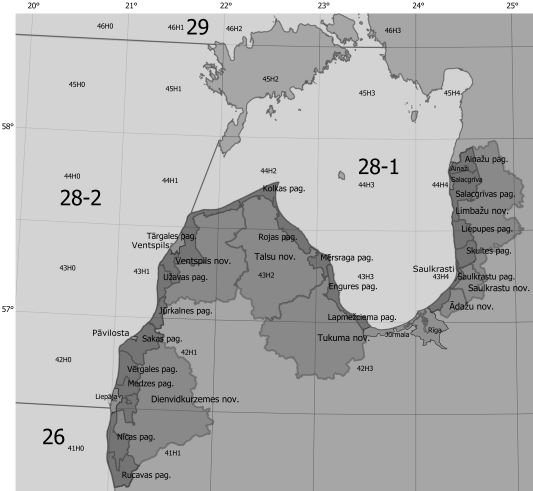
Note. The boundaries of ICES sub-division 28.1 are specified in Annex III to Regulation (EC) No 218/2009 of the European Parliament and of the Council of 11 March 2009 on the submission of nominal catch statistics by Member States fishing in the north-east Atlantic.
Translation © 2025 Valsts valodas centrs (State Language Centre)


|
Latvijas Vestnesis, the official publisher ensures legislative acts systematization function on this site. All Likumi.lv content is intended for information purposes. |
About Likumi.lv News archive For feedback Training Contacts |
Mobile version Terms of service Privacy policy Cookies Accessibility |
|


