Aicinām vēl šonedēļ piedalīties lietotāju apmierinātības aptaujā!
Paldies par viedokli!

Methodology for the Determination of Protection Zones for Energy Infrastructure ObjectsIssued pursuant to 1. General Provisions1. The Regulation prescribes the methodology for the determination of protection zones for energy infrastructure objects - the requirements for the operation and safety of utilities and objects, the requirements for environmental and human protection, the mechanism for the maintenance of protection zones and control of the technical condition thereof, information on servitudes and restrictions related to the relevant objects, utilities, and the protection zones thereof, and also the procedures by which protection zones are established and marked on site. 2. The Regulation shall apply to the following protection zones: 2.1. operational protection zones along electrical power networks; 2.2. operational protection zones along heating networks, their equipment and structures, and also safety protection zones along aboveground heating pipelines with the diameter of 400 millimetres and above; 2.3. operational protection zones around gas pipelines, gas supply installations and structures, gas warehouses and storage facilities, and also safety protection zones around gas pipelines with a pressure above 1.6 megapascals, around gas regulation stations, gas metering stations, natural gas compressor stations, natural gas collection points, gas storage wells, liquefied hydrocarbon gas warehouses, storage facilities and filling stations, warehouses for liquefied hydrocarbon gas cylinders and sales points thereof, and motor vehicle gas filling stations; 2.4. safety protection zones around hydrocarbon extraction points, around pipelines, tanks, storage facilities, processing and reloading establishments of oil, oil products, hazardous chemical substances and products; 2.5. safety protection zones around wind generators with a capacity greater than 20 kilowatts. 2. Operational Protection Zones along Electrical Power Networks2.1. Requirements for the Operation and Safety of Utilities and Objects3. In places where the power line crosses a forest territory, the owner or possessor of electrical power networks shall establish power line routes and clear them of trees and bushes. The width of the power line route shall be: 3.1. for the overhead power lines the voltage of which is: 3.1.1. less than 0.4 kilovolts - a five-metre wide zone; 3.1.2. from 6 to 20 kilovolts - a 13-metre wide zone; 3.1.3. 110 kilovolts - a 26-metre wide zone; 3.1.4. 330 kilovolts - a 54-metre wide zone; 3.2. for cable lines - a three-metre wide zone. [3 December 2013] 3.1 It is prohibited to cultivate trees and bushes along the electrical power network routes which are located on the forest land. [3 December 2013] 3.2 Trees, bushes, and branches felled in the protection zone shall be the property of the owner or legal possessor of the land in accordance with that laid down in the Civil Law. [3 December 2013] 3.3 If the owner or legal possessor of the land has not expressed their wish to deal with the felled bushes within 15 days after being informed of the cleaning works of the route, the owner or possessor of electrical power networks shall deal with them at their own discretion (leaving them on the route or shredding them), maintaining the route in a condition that ensures safe operation of the power line. [3 December 2013] 3.4 If trees in the protection zone outside the overhead power line route are to be felled by the owner or legal possessor of the land, he or she shall inform the owner or possessor of electrical power networks at least 15 days in advance, indicating the cadastral designation of the land parcel in whose overhead power line protection zone the trees will be felled, the cadastre number of the land plot and the owner's contact information. Upon receipt of such information, the owner or possessor of electrical power networks shall, if necessary, organise the disconnection of the relevant power lines free of charge. [3 December 2013] 3.5 If, in accordance with Section 61, Paragraphs ten and 10.1 of the Protection Zone Law, trees in the protection zone are felled by the owner or possessor of electrical power networks: 3.5 1. before felling the potentially endangering trees specified in Section 61, Paragraph five of the Protection Zone Law, they shall be marked with clearly visible signs; 3.5 2. the felled trees shall be trimmed and left not cross-cut in the last metre of the power line route (along the edge of the route), without damaging the quality of the timber, unless the owner or legal possessor of the land and the owner or possessor of electrical power networks have agreed otherwise (Annex 5); 3.5 3. the trees of the forest stand which are left uncut shall not be damaged; 3.5 4. trees and bushes shall be felled so that the stumps of trees and bushes are not higher than 10 cm; 3.5 5. the branches of growing trees shall be felled so as not to damage the trunk of the tree; 3.5 6. the felled trees, tree branches, and bushes shall not be left lying around in the forest stand; 3.5 7. branches shall be cut along with the trunk, leaving no uncut branch stumps; 3.5 8. the felled trees shall not be covered with branches. [3 December 2013] 3.6 The branches of specially protected trees (venerable trees) shall be pruned by an arborist. [3 December 2013] 3.7 When carrying out the planned felling of potentially endangering trees referred to in Section 61, Paragraph five of the Protection Zone Law outside the power line route, the owner or possessor of electrical power networks shall inform the owner or legal possessor of the land of the felling of trees and their further use, sending to the owner (legal possessor) information on the felling of potentially endangering trees (Annex 5), and also shall inform the local government in whose territory the property in which the potentially endangering trees will be felled is located. [3 December 2013] 3.8 The owner or legal possessor of the land shall arrive at the relevant land property within the time specified in the information letter, but not earlier than 15 days after sending the information on the felling of potentially endangering trees, to agree on the procedures for cross-cutting or placing (stacking) the potentially endangering trees referred to in Section 61 of the Protection Zone Law. The owner or possessor of electrical power networks and the owner or legal possessor of the land may agree on a different time and place of arrival or another method for agreeing on the information specified in Annex 5 to this Regulation (by telephone, electronically), and the owner or legal possessor of the land shall contact the owner or possessor of electrical power networks at the telephone number or electronic mail address specified in the information letter. [3 December 2013] 3.9 If, within 30 days after sending information on the felling of potentially endangering trees, a response has not been received from the owner or legal possessor of the land regarding the felling, processing, and placement of trees in accordance with Annex 5 to this Regulation or he or she has not provided the information specified in Annex 5, the trees may be felled without agreement with the owner or legal possessor of the land. [3 December 2013] 3.10 The information letters referred to in Paragraph 3.8 of this Regulation shall be sent to the address of the declared place of residence of the owner or legal possessor of the land, the official electronic address or the electronic communication address specified by him or her. [13 August 2024] 3.11 In an emergency situation declared in accordance with the procedures laid down in laws and regulations or if trees have fallen on an object or are bowing down in such a way that they or their branches disturb the operation of the object, the trees shall be felled by the owner or possessor of electrical power networks in accordance with the procedures laid down in Section 12, Paragraph three, Clauses 1 and 2 of the Law on Forests. [3 December 2013] 4. If the route width of an existing power line has been increased in accordance with Paragraph 3 of this Regulation and the increased area is registered in the State Forest Register as forest land, the relevant area shall be deleted from the State Forest Register based on the data verification report of the forest interim inventory period. 5. [3 December 2013] 6. Expenses for measures for the protection of cable lines against stray currents shall be covered by the operating organisations of electrified railways and trams. 7. In protection zones, legal and natural persons shall comply with the legal requirements of the owner or possessor of electrical power networks. If the person performing the works, i.e. a legal or natural person, violates this Regulation or the legal requirements of the owner or possessor of electrical power networks, the owner or possessor of electrical power networks has the right to suspend the works. 2.2. Requirements for Environmental and Human Protection8. If, while carrying out earthworks, legal or natural persons discover a cable that is not indicated in the technical documentation for the performance of the works, they shall stop the earthworks and ensure the preservation of the cable, and also shall immediately report this to the owner or possessor of electrical power networks and to the local government. If the cable is lifted out of the water by anchor, fishing gear or otherwise, the ship's master or work supervisor shall immediately report this to the owner or possessor of electrical power networks and to the local government. 9. In addition to the restrictions referred to in Sections 35 and 45 of the Protection Zone Law, the following is prohibited in protection zones: 9.1. to be in the territory and premises of electrical power network structures, to open doors, fences, and hatches of electrical installations, to connect to electrical power networks, and to operate switching devices; 9.2. to throw any objects at wires and supports, and also bring any objects close to them; 9.3. to climb onto electrical power network structures, attach, place or secure various objects on them; 9.4. to fly kites, sports model aircraft, and other flying objects. 10. Underwater cable crossings shall be agreed upon with the relevant port authority and marked on port plans and nautical charts. The places where underwater cable lines cross navigable rivers, canals, and reservoirs shall be marked on site with signal signs. The design and placement of signal signs on the shores of water bodies shall be agreed upon with the relevant port authority. Signal signs shall be placed by the owner or possessor of electrical power networks. 11. Regardless of the specified width of the protection zones, work with lifting mechanisms within a 30 meter zone from the outer wire of an overhead power line shall be agreed upon with the owner or possessor of the relevant electrical power networks before commencing work. 2.3. Maintenance of Protection Zones and Control of the Condition Thereof12. The owner or possessor of the object shall maintain the electrical power networks in the protection zone routes in a condition that ensures the operation of the object. The protection zones outside the route, according to the type of land use, shall be maintained in order by the owner or legal possessor of the land or the owner or possessor of electrical power networks upon mutual written agreement. [3 December 2013] 13. The condition of the protection zones shall be controlled by the possessor of electrical power networks within the scope of its competence. 13.1 The owner or possessor of electrical power networks shall conclude a mutual cooperation agreement with valsts akciju sabiedrība "Latvijas valsts meži" [State joint-stock company Latvian State Forests]. The agreement shall provide for the procedures for exchanging information and coordinating the works to be performed. [3 December 2013] 2.4. Information on Restrictions14. The owner or possessor of the relevant electrical power networks is entitled to enter the encumbrance in the Land Register. If the relevant electrical power networks were constructed after 15 July 2005, the expenses related to the marking of encumbrances of protection zones and also of immovable properties related to the protection zones on the land property or use boundary plan and the entering of the encumbrances in the Land Register shall be covered by the owner or possessor of electrical power networks. If the immovable property is used for direct electricity supply to the property of its owner, the expenses related to the marking of encumbrances of protection zones and also of immovable properties related to the protection zones on the land property or use boundary plan and the entering of the encumbrances in the Land Register shall be covered by the land owner. 15. If the owner or possessor of electrical power networks or the owner or user of the restricted land plot changes, the restrictions shall not change. 16. If the location of electrical power networks on the property or their characteristic parameters (nominal voltage) change, only the restrictions and the width of the protection zone (if it changes) shall be reviewed and the documentation shall be clarified accordingly. Changes to restrictions shall be corroborated in the same manner as restrictions are corroborated. 2.5. Establishing and Marking the Protection Zones on Site17. Protection zones shall be marked on site with special information signs (Annex 1). The owner or possessor of electrical power networks shall be responsible for placing and maintaining the information signs in the designated places. 18. The special information signs for marking the protection zones of overhead power lines shall be placed on power line supports at the height of 2.5-3 metres from the ground: 18.1. on all supports - on power lines with a voltage of 110 and 330 kilovolts; 18.2. on straight sections of the route - within visibility, but not further than 500 metres, at the turning points of the route - on power lines with a voltage not exceeding 20 kilovolts. 19. The special information sign shall have the inscription "Protection Zone". The following information shall be indicated on the information sign: 19.1. width of the protection zone (in metres); 19.2. distance of line wires from the ground (in metres); 19.3. nominal voltage value (in kilovolts); 19.4. name and telephone number of the possessor of electrical power networks. 20. The special information signs for marking the protection zones of the cable lines with a voltage of 6 to 20 kilovolts shall be placed on poles at the height of one metre from the ground: 20.1. on straight sections of the route - every 200 metres; 20.2. at the turning points of the route - on the routes without an asphalt surface. 21. The special information signs shall have the inscription "Protection Zone" or "Cable". The following information shall be indicated on the information sign: 21.1. width of the protection zone (in metres); 21.2. cable laying depth (in metres); 21.3. nominal voltage value (in kilovolts); 21.4. name and telephone number of the possessor of electrical power networks. 3. Operational Protection Zones along Heating Networks and Safety Protection Zones along Aboveground Heating Pipelines with the Diameter of 400 Millimetres and above3.1. Requirements for the Operation and Safety of Utilities and Objects22. During the repair of heating networks, their owner or possessor has the right to place the materials, mechanisms, and devices necessary for the repair near the objects being repaired in a five-metre wide zone from the outer edge of heating networks. The owner of the immovable property shall be notified of the works no later than two weeks before they are commenced. 23. Legal and natural persons shall agree upon the conditions for carrying out the works in the protection zone with the owner or possessor of heating networks no later than seven days prior to the commencement of the works referred to in Section 46, Paragraph one, Clause 6 of the Protection Zone Law and shall take the necessary measures to preserve the heating networks. 24. It is permitted to commence the planned repair and reconstruction works of heating networks in the protection zones along motor roads if the time and conditions for their execution have been agreed upon with valsts akciju sabiedrība "Latvijas Valsts ceļi" [State joint-stock company Latvian State Roads]. If it is necessary to prevent an accident, repairs to heating networks shall be permitted without prior agreement. Before commencing the works, the State joint-stock company Latvian State Roads shall be informed thereof. 25. If, while carrying out earthworks, legal or natural persons discover heating networks that are not indicated in the technical documentation for the performance of the works, they shall stop the earthworks and shall immediately report this to the owner or possessor of heating networks and to the local government. 26. In protection zones, legal and natural persons shall comply with the legal requirements of the owner or possessor of heating networks. If the person performing the works, i.e. a legal or natural person, violates this Regulation or the legal requirements of the owner or possessor of heating networks, the owner or possessor of heating networks has the right to suspend the works. 27. Expenses for measures for the protection of heating networks against stray currents shall be covered by the operating organisations of electrified railways and trams. 28. Heating networks may not be exposed, nor may test pits and ditches near them be exposed, except for the cases where works necessary for the operation and repair are being carried out. The exposed sections of heating networks shall be covered within a week after the completion of the abovementioned works. 3.2. Requirements for Environmental and Human Protection29. Any activity that could disrupt the normal operation of heating networks, damage them or cause an accident shall be prohibited in the protection zone, and also the following shall be prohibited: 29.1. for unauthorised persons to be present in the fenced territory and premises of heating network structures, to open their doors, fences and hatches, to operate the switching on, switching off, and control devices; 29.2. to climb onto heating network structures, attach to them, place or secure various objects on them. 30. The crossings of underwater heating networks shall be agreed upon with the relevant port authority and marked on port plans and nautical charts. The places where underwater heating networks cross navigable rivers, canals, and reservoirs shall be marked on site with signal signs. The design and placement of signal signs on the shores of water bodies shall be agreed upon with the relevant port authority. Signal signs shall be placed by the owner of heating networks. 3.3. Maintenance of Protection Zones and Control of the Condition Thereof31. The protection zones shall be maintained in order by the owner or possessor of heating networks or, upon mutual written agreement, by the owner or user of the land. If the land in a protection zone can be used for the previous purposes of use of the immovable property, the protection zone shall be maintained in order by the owner or user of the land. 32. The owner or possessor of heating networks shall clear the protection zone of trees and bushes. 33. If it is necessary to prevent an emergency situation or eliminate the consequences of an emergency, the owner or possessor of heating networks has the right, before acquiring the certificate, to fell individual trees along the heating networks and trim the tree branches that disturb or threaten the operation of heating networks. The State Forest Service shall be notified in advance, but if the activity is planned in a specially protected nature territory (except for the landscape protection and neutral zone of the North Vidzeme Biosphere Reserve) also the relevant regional environmental board of the State Environmental Service or the administration of the specially protected nature territory (if one has been established) shall be notified in advance. The owner or possessor of heating networks is obliged to inform the owner, possessor, or user of the land of the felling of trees within five days after the felling. Felled trees, bushes, and branches shall be the property of the owner or user of the land. 34. The condition of the protection zones shall be controlled by the owner or possessor of heating networks and the local government within the scope of their competence. 3.4. Information on Restrictions35. The owner or possessor of the relevant heating networks is entitled to enter the encumbrances in the Land Register. If the relevant heating networks were constructed after 15 July 2005, the expenses related to the marking of encumbrances of protection zones and also of immovable properties related to the protection zones on the land property or use boundary plan and the entering of the encumbrances in the Land Register shall be covered by the owner or possessor of heating networks. If the immovable property is used for direct heat supply to the property of its owner, the expenses related to the marking of encumbrances of protection zones and also of immovable properties related to the protection zones on the land property or use boundary plan and the entering of the encumbrances in the Land Register shall be covered by the land owner. 36. If the owner or possessor of heating networks or the owner or user of the restricted land plot changes, the restrictions shall not change. 37. If the type of location of heating networks (in ducts, tunnels, in the air or ductless location) on the property changes, only the restrictions and the width of the protection zone (if it changes) shall be reviewed and the documentation shall be clarified accordingly. Changes to restrictions shall be corroborated in the same manner as restrictions are corroborated. 3.5. Establishing and Marking the Protection Zones on Site38. Protection zones shall not be marked on site with special information signs. 39. The location of the protection zones on site shall be determined according to the location of the networks which is marked with manholes or other stationary structures. In order to determine the protection zones on site, the relevant distance shall be measured from the marked network elements. 4. Operational Protection Zones around Gas Pipelines, Gas Supply Equipment and Structures, Gas Warehouses and Storage Facilities, and also Safety Protection Zones around Gas Pipelines with a Pressure above 1.6 Megapascals, Gas Regulation and Metering Stations, Natural Gas Compressor Stations and Collection Points, Gas Storage Wells, Liquefied Hydrocarbon Gas Warehouses, Storage Facilities and Filling Stations, Warehouses for Liquefied Hydrocarbon Gas Cylinders and Sales Points, and Motor Vehicle Gas Filling Stations4.1. Requirements for the Operation and Safety of Utilities and Objects40. The relevant owner or possessor of gas pipelines, gas supply equipment and structures or gas storage wells shall clear the following of bushes and trees: 40.1. a gas pipeline route in which the pressure in the gas pipelines is up to 0.4 megapascals - in a metre wide zone on each side of the gas pipeline axis; 40.2. a gas pipeline route in which the pressure in the gas pipelines is above 0.4 megapascals, but not above 1.6 megapascals - in a two-metre wide zone on each side of the outer edge of the gas pipeline; 40.3. a gas pipeline route in which the pressure in the gas pipelines is above 1.6 megapascals, and the area of the closing devices belonging to the gas pipelines, and also the route of the purification and intelligent piston launch and reception chamber assemblies in a zone of up to 15 metres wide which consists of not less than 3 metres from one side of the gas pipeline axis or the relevant side of the enclosure of the previously listed object and not less than 9 metres, but not more than 12 metres from the other side of the gas pipeline axis and the relevant side of the enclosure of the previously listed object, taking into account the actual location of the gas pipeline and the relevant objects on site; 40.4. in protection zones around liquefied gas or natural gas filling stations - in a 10-metre wide zone behind the territory fence; 40.5. in protection zones around gas storage wells: 40.5.1. 40 metres from the axis of the equipment (fountain fixture) of the above-ground part of the well if the well is located in a natural gas storage area and is connected to a collector layer; 40.5.2. 30 metres from the axis of the equipment (fountain fixture) of the above-ground part of the well if the well is not connected to the natural gas storage collector layer or is located outside the natural gas storage area; 40.6. in protection zones around gas collection points and compressor stations - in a 3-metre wide zone behind the territory fence. [13 August 2024] 40.1 The relevant owner or possessor of gas pipelines, gas supply equipment and structures or gas storage wells shall inform the owner or legal possessor of the land by sending a notice regarding the performance of cleaning works of the route or protection zone to the address of the declared place of residence of the owner or legal possessor of the land, the official electronic address or the electronic communication address specified by him or her, and, in the case referred to in Sub-paragraph 40.3 of this Regulation, shall add information on the width of the route to be cleaned. If the owner or legal possessor of the land has not expressed their wish to deal with the felled trees and bushes within 15 days after being informed of the cleaning works of the route, the owner or possessor of the gas pipelines, gas supply equipment and structures or gas storage wells shall deal with them at their own discretion (leaving them on the route or shredding them), maintaining the route and protection zones in a condition that ensures safe operation of the gas pipelines, gas supply equipment and structures, and gas storage wells. [13 August 2024] 40.2 The owner or legal possessor of the land shall be prohibited from planting trees and bushes in the territories necessary for the operation of the objects specified in Sub-paragraphs 40.3, 40.5, and 40.6 of this Regulation without written approval from the owner of the said objects. [13 August 2024] 41. The owner or possessor of such gas pipelines in which the pressure is above 1.6 megapascals, and also the owner or possessor of gas regulation and metering stations, natural gas compressor stations and collection points, gas storage wells, liquefied hydrocarbon gas warehouses, storage facilities and filling stations, warehouses for liquefied hydrocarbon gas cylinders and sales points, and motor vehicle gas filling stations shall inform the public of the restrictions in the safety protection zones and of the dangers associated with staying in the protection zones, sending the abovementioned information once a year to the relevant local government which shall publish this information on its website. [13 August 2024] 42. Before commencing works in operational protection zones outside populated areas (if the pressure in the gas pipeline is 1.6 megapascals or less) and in operational protection zones (if the pressure in the gas pipeline is above 1.6 megapascals), the legal or natural persons shall, together with the owner or possessor of the gas pipeline, determine and agree upon the locations of roadways in order to prevent possible damage to the gas pipeline when crossing it. The designations and arrangement of temporary crossing points shall be determined in each specific case by the owner or possessor of the gas pipeline. 43. Underground gas pipelines may not be exposed, nor may test pits and ditches near them be exposed, except for the cases where works necessary for the operation and repair are being carried out. The exposed sections of the gas pipeline shall be covered within a week after the completion of the abovementioned works. 44. In protection zones, legal and natural persons shall comply with the legal requirements of the owner or possessor of gas pipelines, gas supply equipment and structures, gas warehouses and storage facilities, gas pipelines in which the pressure is above 1.6 megapascals, gas regulation stations, gas metering stations, natural gas compressor stations, natural gas collection points, gas storage wells, liquefied hydrocarbon gas warehouses, storage facilities, and filling stations, warehouses for liquefied hydrocarbon gas cylinders and sales points, and motor vehicle gas filling stations. If the persons performing the works, i.e. legal or natural persons, violate the requirements of this Regulation or the legal requirements of the owner or possessor of gas pipelines, gas supply equipment and structures, gas warehouses and storage facilities, gas pipelines in which the pressure is above 1.6 megapascals, gas regulation stations, gas metering stations, natural gas compressor stations, natural gas collection points, gas storage wells, liquefied hydrocarbon gas warehouses, storage facilities, and filling stations, warehouses for liquefied hydrocarbon gas cylinders and sales points, and motor vehicle gas filling stations, the owner or possessor has the right to suspend the works. 4.2. Requirements for Environmental and Human Protection45. When managing gas pipelines, gas supply equipment and structures, gas warehouses and storage facilities, their owner or possessor shall: 45.1. ensure that the gates of the fences of taps, connection points, condensate collection, and purification equipment, launching and reception areas and other gas supply facilities are closed and locked; 45.2. install fencing for all beam-type surface crossings to prevent unauthorised persons from walking on the gas pipeline. Crossings shall be marked with a special information sign (Annex 2); 45.3. prevent the runoff of surface water in the direction of the axis of the gas pipeline in order to prevent soil erosion in ditches and river banks under the gas pipeline, and also the expansion of ravines and erosion in the protection zone of the gas pipeline. 46. The crossings of underwater gas pipelines shall be agreed upon with the relevant port authority and marked on port plans and nautical charts. The places where underwater gas pipelines cross navigable rivers, canals, and reservoirs shall be marked on site with signal signs. The design and placement of signal signs on the shores of water bodies shall be agreed upon with the relevant port authority. Signal signs shall be placed by the owner or possessor of gas pipelines. 4.3. Maintenance of Protection Zones and Control of the Condition Thereof47. The owner or possessor of gas pipelines, gas supply equipment and structures, gas warehouses and storage facilities shall, in accordance with their competence, control the works related to the maintenance of protection zones and also the condition of protection zones. 48. If it is necessary to prevent an emergency situation or eliminate the consequences of an emergency, the owner or possessor of gas pipelines, gas supply equipment and structures, gas warehouses and storage facilities has the right, before acquiring the felling certificate, to fell individual trees and trim the tree branches that disturb or threaten the operation of gas pipelines, gas supply equipment and structures, gas warehouses and storage facilities. The State Forest Service shall be notified in advance, but if the activity is planned in a specially protected nature territory (except for the landscape protection zone and neutral zone of the North Vidzeme Biosphere Reserve) also the relevant regional environmental board of the State Environmental Service or the administration of the specially protected nature territory (if one has been established) shall be notified in advance. The owner or possessor of gas pipelines, gas supply equipment and structures, gas warehouses and storage facilities is obliged to inform the owner, possessor, or user of the land of the felling of trees within five days after the felling. [13 August 2024] 48.1 Trees and bushes felled during the maintenance of a protection zone, prevention of an emergency situation or elimination of the consequences of an emergency shall be the property of the owner or legal possessor of the land in accordance with the Civil Law. [13 August 2024] 4.4. Information on Restrictions49. The owner or possessor of gas pipelines, gas supply equipment and structures, gas warehouses and storage facilities is entitled to enter encumbrances in the Land Register. If gas pipelines, gas supply equipment and structures, gas warehouses and storage facilities were constructed after 15 July 2005, the expenses related to the marking of encumbrances of protection zones and also of immovable properties related to the protection zones on the land property or use boundary plan and the entering of the encumbrances in the Land Register shall be covered by the owner or possessor of gas pipelines, gas supply equipment and structures, gas warehouses and storage facilities. If the immovable property is used for direct gas supply to the property of its owner, the expenses related to the marking of encumbrances of protection zones and also of immovable properties related to the protection zones on the land property or use boundary plan and the entering of the encumbrances in the Land Register shall be covered by the land owner. 50. If the owner or possessor of gas pipelines, gas supply equipment and structures, gas warehouses and storage facilities or the owner or user of the restricted land plot changes, the restrictions shall not change. 51. If the location of gas pipelines, gas supply equipment and structures, gas warehouses and storage facilities on the property (routes) or the characteristic parameters (gas pipeline pressure) change, only the restrictions and the width of the protection zone (if it changes) shall be reviewed and the documentation shall be clarified accordingly. Changes to restrictions shall be corroborated in accordance with the procedures for corroborating restrictions in the protection zones of gas pipelines, gas warehouses and storage facilities. 4.5. Establishing and Marking the Protection Zones on Site52. On site, protection zones shall be designated around the gas pipelines where the pressure is above 1.6 megapascals. 53. Protection zones on site shall be marked with a special information sign (Annex 2). The owner or possessor of gas pipelines shall be responsible for placing and maintaining information signs in the designated places. 54. The special information sign for marking protection zones shall be placed at the height of 1.5-2 metres from the ground: 54.1. on straight sections of the route - within visibility, but not further than 500 metres; 54.2. at the turning points of the route; 54.3. at the places where gas pipelines are crossed by motor roads, railways, and underground engineering utilities; 54.4. at the places where gas pipelines cross water bodies, watercourses, and ravines; 54.5. in areas used for agriculture - on the border of the cultivated land and forest land. 55. Cathodic protection control and measurement posts can be used to place special information signs. 56. The special information sign shall have the inscription "Dangerous! Gas pipeline. Explosion possible." The following information shall be indicated on the information sign: 56.1. width of the protection zone (in metres); 56.2. address and telephone number of the owner of the gas pipeline, gas warehouse or storage facilities. 57. The special information sign shall provide the opportunity to: 57.1. visually determine the location of the gas pipeline during patrolling; 57.2. determine the location of a gas pipeline when carrying out any works within its protection zone. 5. Safety Protection Zones around Hydrocarbon Extraction Points, around Pipelines, Tanks, Storage Facilities, Processing and Reloading Establishments of Oil, Oil Products, Hazardous Chemical Substances and Products5.1. Requirements for the Operation and Safety of Utilities and Objects58. The owner or possessor of hydrocarbon extraction points, pipelines, tanks, storage facilities, processing and reloading establishments of oil, oil products, hazardous chemical substances and products shall maintain them in a fire-safe condition and shall clear the following of dry grass, bushes, and trees: 58.1. pipeline route - in a five-metre wide zone on each side of the boundary pipeline; 58.2. in the protection zone around tanks, pumping and filling stations, reservoir parks, filling and unloading platforms, and oil and oil product heating points - a 10-metre wide zone behind the territory fence. 59. The owner or possessor of hydrocarbon extraction points, pipelines, tanks, storage facilities, processing and reloading establishments of oil, oil products, hazardous chemical substances and products shall inform the public of the restrictions in the protection zones and of the dangers associated with staying in the protection zones by publishing the abovementioned information once a year in a local newspaper, and also by sending it to the relevant local government. 60. Before commencing works in protection zones, the legal or natural persons shall, together with the possessor of the pipeline of oil and oil products, determine the locations of the roadways in order to prevent possible damage to the oil and oil product pipeline when crossing it. The designations and arrangement of temporary crossing points shall be determined in each specific case by the owner or possessor of the oil and oil product pipeline. 61. Underground pipelines of oil and oil products may not be exposed, nor may test pits and ditches near them be exposed, except for the cases where works necessary for the operation and repair are being carried out. The exposed sections of underground pipelines of oil and oil products shall be covered within a week after the completion of the relevant works. 62. In protection zones, legal and natural persons shall comply with the legal requirements of the owner or possessor of hydrocarbon extraction points, pipelines, tanks, storage facilities, processing and reloading establishment of oil, oil products, hazardous chemical substances and products. If the persons performing the works, i.e. legal or natural persons, violate this Regulation or the legal requirements of the owner or possessor of hydrocarbon extraction points, pipelines, tanks, storage facilities, processing and reloading establishments of oil, oil products, hazardous chemical substances and products, the owner or possessor of hydrocarbon extraction points, pipelines, tanks, storage facilities, processing and reloading establishments of oil, oil products, hazardous chemical substances and products has the right to suspend the works. 5.2. Requirements for Environmental and Human Protection63. The owner or possessor of hydrocarbon extraction points, pipelines, tanks, storage facilities, processing and reloading establishments of oil, oil products, hazardous chemical substances and products shall: 63.1. ensure access to any section of the pipeline carrying oil, oil products or hazardous chemical substances or products if an accident has occurred and it is necessary to take environmental protection measures; 63.2. develop a scheme of measures to eliminate accidents and their consequences; 63.3. ensure the availability of the necessary equipment, personnel, and oil product collection means (sorbents) in the event of an accident; 63.4. prevent the runoff of surface water in the direction of the axis of the pipeline of oil and oil products, hazardous chemical substances and products in order to prevent the erosion of the soil underneath it into the banks of ditches and rivers, and also the expansion of ravines and erosion in the protection zone of the pipeline of oil, oil products and hazardous chemical substances and products. 64. The crossings of underwater pipelines of oil and oil products shall be agreed upon with the relevant port authority and marked on port plans and nautical charts. The places where underwater pipelines of oil and oil products cross navigable rivers, canals, and reservoirs shall be marked on site with signal signs. The design and placement of signal signs on the shores of water bodies shall be agreed upon with the relevant port authority. Signal signs shall be placed by the owner or possessor of pipelines of oil and oil products. 5.3. Maintenance of Protection Zones and Control of the Condition Thereof65. The owner or possessor of hydrocarbon extraction points, pipelines, tanks, warehouses and storage facilities of oil, oil products, hazardous chemical substances and products shall, in accordance with their competence, control the works related to the maintenance of protection zones and also the condition of protection zones. 5.4. Information on Restrictions66. When determining restrictions in the protection zones of the objects to be newly constructed, and also if land ownership rights in rural areas are corroborated in the Land Register, the owner or possessor of hydrocarbon extraction points, pipelines, tanks, warehouses and storage facilities of oil, oil products, hazardous chemical substances and products shall conclude a land lease agreement with the owner or user of the land. The expenses for corroborating the abovementioned agreement in the Land Register shall be covered by the owner or possessor of hydrocarbon extraction points, pipelines, tanks, warehouses and storage facilities of oil, oil products, hazardous chemical substances and products. 67. The expenses for corroborating restrictions in the Land Register shall be covered by the owner or possessor of hydrocarbon extraction points, pipelines, tanks, warehouses and storage facilities of oil, oil products, hazardous chemical substances and products. 68. If the owner or possessor of hydrocarbon extraction points, pipelines, tanks, pipes, warehouses and storage facilities of oil, oil products, hazardous chemical substances or products or the owner or user of the restricted land plot changes, the restrictions shall not change. 69. If the location of hydrocarbon extraction points, pipelines, tanks, pipes, warehouses and storage facilities of oil, oil products, hazardous chemical substances and products on the property or the characteristic parameters (geometric dimensions) change, only the restrictions shall be reviewed and the documentation shall be clarified accordingly. Changes to restrictions shall be corroborated in the same manner as restrictions in protection zones are corroborated. 70. If the restrictions imposed make it impossible to use the property for the previous purposes of use of the immovable property, the owner or possessor of hydrocarbon extraction points, pipelines, tanks, warehouses and storage facilities of oil, oil products, hazardous chemical substances and products shall, within three months after the restrictions are imposed, conclude a purchase and sale agreement or lease agreement on the immovable property with the land owner. The expenses for corroborating the purchase and sale agreement or lease agreement in the Land Register shall be covered by the owner or possessor of hydrocarbon extraction points, pipelines, tanks, warehouses and storage facilities of oil, oil products, hazardous chemical substances and products. 5.5. Establishing and Marking the Protection Zones on Site71. Protection zones around hydrocarbon extraction points, pipelines, tanks, warehouses and storage facilities of oil, oil products, hazardous chemical substances and products shall be marked on site with a special information sign (Annex 3). The owner or possessor of hydrocarbon extraction points, pipelines, tanks, warehouses and storage facilities of oil, oil products, hazardous chemical substances and products shall be responsible for placing and maintaining the information signs in the designated places. 72. The special information sign for marking protection zones shall be placed at the height of 1.5-2 metres from the ground: 72.1. on straight sections of the route - within visibility, but not further than a kilometre; 72.2. at the turning points of the route; 72.3. at the places where oil and oil product pipelines are crossed by motor roads, railways, and underground engineering utilities; 72.4. at the places where oil and oil product pipelines cross water bodies, watercourses, and ravines; 72.5. in areas used for agriculture - on the border of the cultivated land and forest land. 73. Cathodic protection control and measurement posts can be used to place special information signs. 74. The special information sign shall have the inscription "Flammable!" and the name of the relevant protection zone (Annex 3). The following information shall be indicated on the information sign: 74.1. width of the protection zone (in metres); 74.2. address and telephone number of the owner or possessor of the hydrocarbon extraction point, pipelines, tanks, storage facilities of oil (oil products) or hazardous chemical substances (products). 75. The special information sign shall provide the opportunity to: 75.1. visually determine the location of oil (oil product) pipelines, hydrocarbon extraction points, pipelines, tanks, warehouses and storage facilities of hazardous chemical substances (hazardous chemical substance products) during patrolling; 75.2. determine the location of oil (oil product) pipelines, hydrocarbon extraction points, pipelines, tanks, warehouses and storage facilities of hazardous chemical substances (hazardous chemical substance products) when carrying out any works within their protection zone. 6. Safety Protection Zones around Wind Generators6.1. Requirements for the Operation and Safety of Utilities and Objects76. It is permitted to commence the planned wind generator repair and reconstruction works in the protection zones along motor roads if the time and conditions for their execution have been agreed upon with the State joint-stock company Latvian State Roads. If it is necessary to prevent an accident, the wind generator may be repaired without prior agreement. Before commencing the works, the State joint-stock company Latvian State Roads shall be informed thereof. 77. In protection zones around wind generators, legal and natural persons shall comply with the legal requirements of the owner or possessor of the wind generator. If the person performing the works, i.e. a legal or natural person, violates this Regulation or the legal requirements of the owner or possessor of the wind generator, the owner or possessor of the wind generator has the right to suspend the works. 6.2. Requirements for Environmental and Human Protection78. Any activity that could disrupt the normal operation of the wind generator, damage it or cause an accident shall be prohibited in the protection zone, and also the following shall be prohibited: 78.1. for unauthorised persons to be present in the fenced territory and premises of the wind generator, to open its doors, fences, and also to operate the switching on, switching off, and control devices; 78.2. to climb onto a wind generator, attach to it, place or secure various objects on it; 78.3. to fly kites, sports model aircraft, and other flying objects. 6.3. Maintenance of Protection Zones and Control of the Condition Thereof79. The protection zones shall be maintained in order by the owner or possessor of the wind generator. 80. The condition of the protection zones shall be controlled by the owner or possessor of the wind generator and the local government within the scope of their competences. 6.4. Information on Restrictions81. The expenses related to corroborating restrictions in the Land Register in accordance with the requirements of the Land Register Law shall be covered by the owner or possessor of the wind generator. 82. If the possessor of the wind generator or the owner or user of the restricted land plot changes, the restrictions shall not change. 6.5. Establishing and Marking the Protection Zones on Site83. Protection zones shall be marked on site with special information signs (Annex 4). The owner or possessor of the wind generator shall be responsible for placing and maintaining the information signs in the designated places. 84. The special information signs for marking the protection zones of wind generators shall be placed at the height of 1.5-2 metres from the ground. 85. The information sign shall have the inscription "Wind generator protection zone". The following information shall be indicated on the information sign: 85.1. width of the protection zone (in metres); 85.2. name, address, and telephone number of the owner or possessor of the wind generator. Prime Minister A. Kalvītis Minister for Economics J. Strods
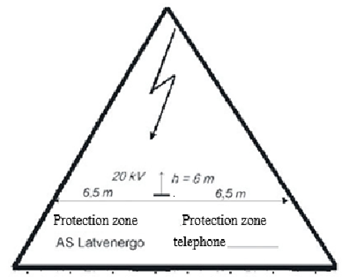
Annex 1 [13 August 2024] Special Information Signs for Marking Protection Zones along Electrical Power Networks on Site
Figure 1.1
Figure 1.2
Figure 1.3
Figure 1.4
Annex 2 [13 August 2024] Special Information Sign for Marking Protection Zones around Gas Pipelines on Site1. For marking a gas pipeline with a pressure above 1.6 megapascals and an operational protection zone of 15 m on each side of the axis of the gas pipeline, the sample special information sign shall be as follows:
2. Sign dimensions shall be 120 x 190 mm. 3. Background - yellow colour shade RAL1003.
Annex 3 Special Information Sign for Marking Protection Zones around Hydrocarbon Extraction Points, Pipelines and Tanks for Oil, Oil Products, Hazardous Chemicals and Products on Site
Minister for Economics J. Strods
Annex 4 Special Information Sign for Marking Protection Zones of Wind Generators on Site
Minister for Economics J. Strods
Annex 5 Information/Agreement on Felling Trees in the Protection Zone of Overhead Power Lines[3 December 2013] In accordance with Section 61, Paragraph 10.1 of the Protection Zone Law which stipulates that, according to the methodology for the determination of the protection zone of the relevant object, the owner or legal possessor of the object is entitled to fell only those trees which have not been felled by the owner or legal possessor of the land and which, in accordance with Section 61, Paragraph five of the Protection Zone Law, are potentially endangering trees, the owner or legal possessor of the land and the owner or possessor of electrical power networks shall agree on the following methods of processing and placing the felled trees.
I. Information provided by the owner or legal possessor of electrical power networks
potentially endangering trees have been identified and marked in the protection zone of power lines. To prevent a threat to the operation of power lines, these trees must be felled. We ask you to appear on _______________________________ at _____________
to agree on the method of processing and placement of trees. If you are unable to arrive at the specified time, please arrange the time of arrival by calling _____________ or writing to the email address ______________________.
Date ______________________ II. Information provided by the owner or legal possessor of the land 1. Performance of works
2. Timber cross-cutting
3. Timber stacking
Date ______________________
Date ______________________ Translation © 2025 Valsts valodas centrs (State Language Centre) |
Document information
Title: Enerģētikas infrastruktūras objektu aizsargjoslu noteikšanas metodika
Status:
In force
Language:   Related documents
|
||||||||||||||||||||||||||||||||||||||||||||||||||||||||||||||||||||||
|
Latvijas Vestnesis, the official publisher ensures legislative acts systematization function on this site. All Likumi.lv content is intended for information purposes. |
About Likumi.lv News archive For feedback Training Contacts |
Mobile version Terms of service Privacy policy Cookies Accessibility |
|