Aicinām vēl šonedēļ piedalīties lietotāju apmierinātības aptaujā!
Paldies par viedokli!

Implementation Plan 2024-2027 for Housing Affordability Guidelines 2023-20271. The Implementation Plan 2024-2027 for Housing Affordability Guidelines 2023-2027 (hereinafter - the Plan) shall be approved. 2. The Ministry of Economics shall be determined as the responsible authority in the implementation of the Plan, while the Ministry of Finance, the Ministry of Smart Administration and Regional Development, the Ministry of Justice, and the Ministry of Welfare shall be determined as the co-responsible authorities. 3. The responsible and co-responsible authorities shall implement the tasks included in the Plan in 2024 and 2025 in line with the State budget funds allocated for such purpose. The issue of allocating additional State budget funds for 2026 and subsequent years for the implementation of the Plan shall be discussed in the Cabinet within the process of preparing the draft law on the State budget for the current year and the medium-term budget framework, along with the applications for the priority measures submitted by all ministries and central State institutions, considering the financial possibilities of the State budget. If, during the process of preparing the draft law on the State budget, additional State budget funding for the implementation of the tasks outlined in the Plan is not allocated or is allocated partially, the relevant State authorities responsible for the implementation of the measures specified in the Plan shall ensure the implementation of those measures provided for in the Plan for which the State budget funds are sufficient. Prime Minister E. Siliņa Minister for Economics V. Valainis
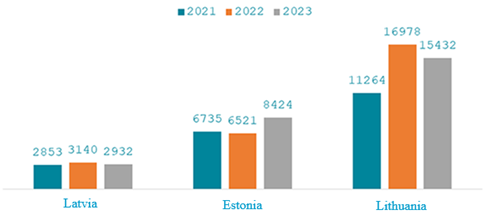
(Cabinet Order No. 1054 of 9 December 2024) Implementation Plan 2024-2027 for Housing Affordability Guidelines 2023-2027Table of Contents Summary of the Plan Description of the Current Situation Measures Outlined in the Plan for 2024-2027 1. Action Direction: Support for Vulnerable Population Groups 2. Action Direction: Support for Middle-income Households 3. Action Direction: Support for Upper-middle-income Households 4. Action Direction: Support for the Improvement of the Existing Housing Stock Abbreviations Altum - Akciju sabiedrība "Attīstības finanšu institūcija Altum" [joint-stock company Development Finance Institution Altum] BIS - Building Information System SCCB - State Construction Control Bureau CSB - Central Statistical Bureau EIB - European Investment Bank MoE - Ministry of Economics EU - European Union FECs - financial and economic calculations MoF - Ministry of Finance LB - Latvijas Banka FLA - Finance Latvia Association ALCL - Association of Large Cities of Latvia MoW - Ministry of Welfare LABAM - Latvian Association of Building Administrators and Managers LALRG - Latvian Association of Local and Regional Governments OECD - Organisation for Economic Co-operation and Development CRPC - Consumer Rights Protection Centre MoJ - Ministry of Justice VNĪ - VAS "Valsts nekustamie īpašumi" [State joint-stock company State Real Estate] Summary of the Plan By Cabinet Order No. 739 of 8 November 2023, the Housing Affordability Guidelines 2023-2027 (hereinafter - the Guidelines)1 were adopted, which determine the development of housing affordability policy covering the period until 2027. The Guidelines include action directions, policy indicators, and set of tasks to promote housing affordability, providing solutions for ensuring housing affordability for households of different income levels, including the lowest-income households, and also to ensure the improvement of both the existing housing stock and the development of a new housing stock. The Guidelines define four problem areas within the framework of which action is required to promote housing affordability: 1. Vulnerable persons do not receive support or support for addressing housing affordability issues that is appropriate to our times, and there is a shortage of high-quality housing intended for local government assistance. 2. There is a shortage of affordable high-quality rental dwellings. 3. The amount of new housing built for purchase or rent is insufficient. 4. Investment in housing maintenance and improvement is insufficient. Based on the evaluation of the identified issues, the objective of housing policy, action directions for their achievement, and performance-based indicators have been defined and a vision of the necessary directions for the investment of public funding has been presented. The Implementation Plan 2024-2027 for Housing Policy Guidelines (hereinafter - the Plan) was developed in the course of implementing Paragraph 3.1 of Cabinet Order No. 739 of 8 November 2023, On Housing Affordability Guidelines 2023-2027, stating "The Ministry of Economics shall prepare and the Minister for Economics shall, in accordance with the established procedures, submit to the Cabinet by 1 July 2024 the plan for the implementation of the Guidelines". The measures outlined in the Plan will contribute to achieving the objective and action directions of the Guidelines, ensuring the continuity of the policy planning documents previously approved by the Cabinet and the further development of the initiated policy. In order to reduce the administrative burden in the development of immovable property, on 2 April 2024, when examining the informative report on the action plan for the reduction of the administrative burden in the development of immovable property, the Cabinet approved the action plan of nearly 60 measures for the reduction of the administrative burden in the development of immovable property that will promote faster and more efficient construction of housing. Solving housing affordability matters is also included in the government action plan which provides for the improvement of housing affordability by increasing investments in the construction and renovation of dwellings, including rental housing, in various Latvian regions2. The tasks of the Plan provide for a series of amendments to laws and regulations which currently establish the procedures by which the State or a local government provides assistance to households in resolving housing matters. Since the adoption of the Guidelines, the tasks 3.1, 3.1.13, 4.14 and 4.25 of the action direction have been completed, and no additional measures are planned for the implementation of the tasks. As for task 4.76 of the Guidelines, in the course of evaluating the current relevance and implementation aspects of the European Union fund support measures under the responsibility of the Ministry of Economics, including the priory areas requiring support, the Ministry has initiated a proposal for amendments to the European Union Cohesion Policy Programme 2021-2027 which provides for redirecting the funding initially intended for measure 4.3.1.4 to support measure 4.3.1.3 "Renovation of social housing or construction of new social housing" under the responsibility of the Ministry of Economics, within the framework of which it is planned to provide adequate housing to social housing assistance recipients, thereby not only addressing the provision of housing affordability for individuals but also reducing the waiting lists for local government rental and social apartments nationwide. The procedure for the harmonisation of the initiated amendments with the European Commission has been commenced. If the European Commission takes the decision to accept the abovementioned amendments to the European Union Cohesion Policy Programme 2021-2027, measure 4.3.1.4 will not be implemented accordingly. Annex 1 includes an indicative evaluation of the impact on State and local government budgets. Description of the Current Situation Housing affordability is a crucial precondition for economic development. The challenges posed by housing affordability and its consequences affect a very large group of households in Latvia. Based on the market prices of new dwellings, around 75 % of all households cannot afford to purchase new dwelling, as a result of which the construction of new dwellings in Latvia falls well behind the neighbouring countries and takes place mostly in Riga and its surroundings where household income is higher than in the rest of the territory of the country. Although the shortage of new dwellings is evident throughout the territory of the country, the greatest shortage of new dwellings, both for purchase and for rent, is in the regional development centres of the country, where economic activity and employment opportunities are increasing. For local governments and companies, one of the most significant obstacles to attracting highly qualified employees is the shortage of modern and adequate housing within the territory of local governments, and also cautious lending policies of commercial banks for the construction of a new housing stock. Figure 1 Number of dwellings commissioned in the Baltic States, 2021-2023
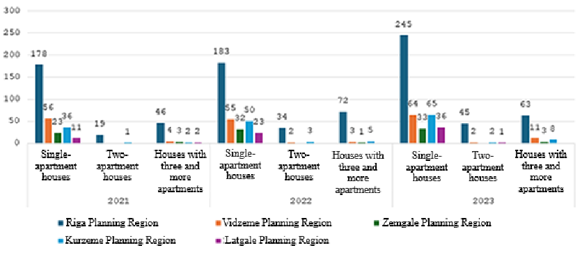
Source: Data from the Portal of Official Statistics of the Baltic States7 As suggested by Figure 1, in terms of construction of new housing, Latvia falls well behind the neighbouring countries. While approximately 9000 dwellings were put into service in Latvia between 2021 and 2023, in Estonia 21.6 thousand and in Lithuania 43.6 thousand dwellings were put into service, which is nearly five times more than in Latvia. When calculating the proportion of dwellings put into service in relation to the total number of dwellings in the country, in 2023, new dwellings in Latvia accounted for 0.27 % of the total number of dwellings, while in Estonia and Lithuania they accounted for 1.13 % and 1.03 % of the total number of dwellings accordingly.8 The OECD average for the construction of new dwellings is around 1 % of the total housing stock in a country. It would be necessary to construct around 10 000 new dwellings annually for Latvia to be able to reach the OECD average. Housing construction activity is closely related to the purchasing power of households which in Latvia is around 70 % of the average purchasing power of European household, while this figure is slightly higher in Estonia reaching 72 % and stands at 88 % in Lithuania9. Although the purchasing power of Estonian households is not significantly higher than that of Latvian households, the pace of the construction of new dwellings in Estonia is considerably higher than in Latvia. According to the economists of Latvijas Banka, some of the reasons hindering the construction of new housing in Latvia are the shadow economy, rapid depopulation, and uneven regional development.10 Figure 2 Number of construction permits issued in planning regions by classification of residential buildings, 2021-2023
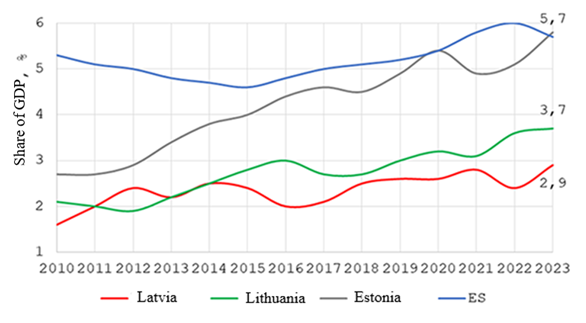
Source: Information provided by the SCCB Over the past three years, 62 % of all issued construction permits have been issued to residential buildings which are to be constructed within the territory of Riga Planning Region where the majority of those permits (68 %) have been issued for single-apartment buildings. 81 % of all construction permits issued to multi-apartment residential buildings (buildings with three and more apartments) have been issued for the construction of buildings in Riga Planning Region. Overall, the number of issued construction permits tends to increase, with the largest contribution provided by permits issued for the construction of private houses within the territory of Riga Planning Region. The low activity of the construction of new housing is mostly attributable to the low income of households which are not commensurate with the financial resources necessary for households to improve their housing situation on their own, which is why the State plays a crucial role in solving housing affordability matters. Although household income is increasing every year, so do construction costs which leads to a situation where the purchase or rent of new, energy-efficient housing, and also the renovation of existing housing without State support is financially viable only for the most affluent households in Latvia, which are residing mainly in Riga and its surroundings. Figure 3 Gross investment in housing in relation to GDP between 2010 and 2023, %
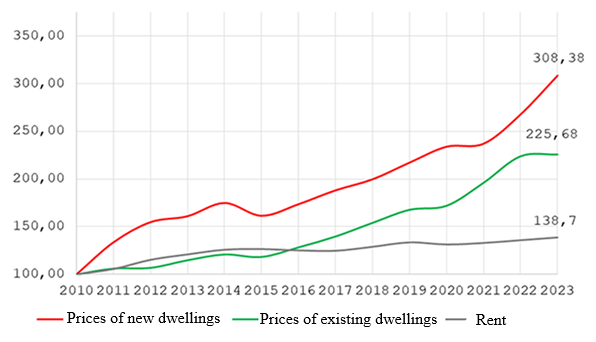
Source: Eurostat11 The construction of the housing stock is also part of the overall national economic activity. As suggested by Figure 3, investment in housing (both in construction and general investment, including renovation) have fluctuated between 2 % and 3 % of the total national GDP over the past decade, while in 2023 the share of housing investment was nearly twice as low as the investments in Estonia. Encouraging more investment in housing development would also boost the national economy which is essential for improving the well-being of the population. In comparison with other EU Member States, only Poland and Greece report lower levels of investment in housing. Figure 4 Housing price index in Latvia between 2010 and 2023, 2010=100
Source: Eurostat12 Although housing construction and investment in housing are among the lowest in the EU, compared to 2010 housing prices, the increase in the prices of new dwellings ranks as the third highest among EU Member States. In the segment of existing dwellings which accounts for nearly the entire housing market in Latvia the increase in price for housing ranks as the fourth highest among EU Member States. The price increase has been smaller in the rental market, where housing rent has increased by 38.7 % since 2010 which corresponds to the EU average. Given that in Latvia 82.8 % of households own their dwelling13 and only 7.6 % of all new dwellings were constructed after 200114, most households reside in dwellings that are outdated, are not energy-efficient, and do not meet the current requirements. Insufficient household income is the main reason why the housing stock in Latvia is outdated; however, with the support from the State and local governments it is possible to ensure that the costs of acquiring, renting, or renovating housing are kept as low as possible through various aid schemes. The Ministry of Economics has developed aid schemes for resolving housing affordability matters for different population groups that partly resolve housing affordability matters based on the level of household income: • for the lowest-income households requiring assistance in solving housing matters, an aid scheme has been developed that provides financial support for the construction or renovation of social housing; • for middle-income households whose income is too low to buy or rent a dwelling at market prices but too high to be eligible for local government assistance in resolving housing matters; • for upper-middle-income households whose members have acquired vocational or higher education, or families with children, in order to receive a guarantee to make the down payment for the purchase or construction of housing with a mortgage loan, and also for large families and families raising a child with a disability, the subsidy "Balsts" is available which is a one-time State aid to reduce the down payment; • financial support is also available to owners of private houses and apartment houses for the renovation of their homes and the improvement of energy efficiency. Housing affordability should also be addressed in the context of regional policy, as affordable housing is crucial for reducing regional development disparities and the national economic growth in general. Due to the underdeveloped rental market, mobility opportunities in Latvian regions are very limited; therefore, in cases where people are offered employment in another region, finding a suitable housing is challenging, which, in turn, hampers economic growth potential for both companies and households. The problem in the regions is also intensified by the quality of the existing housing stock and the fact that the construction of new housing stock is well behind the region of the capital. Investment in housing is crucial for the development of national economy as it promotes better employment opportunities by improving labour mobility within the country. The volume of housing construction needs to be increased in residential areas with growing business activity and high labour demand to better respond to the rising demand for housing, keep the housing prices at a level that corresponds to the population's purchasing power, and facilitate labour mobility. Rising housing expenditures and housing affordability for low-income and middle-income households are problems across the entire territory of Latvia. Assistance in solving housing matters provided by the State and local governments is ensured within the framework of social policy, primarily in the field of social assistance where a local government provides support to persons who need it and are unable to provide the relevant need on their own. However, social policy interventions can only play a complementary, rather than a substitutive, role in the development of housing policy. At the same time, it is important to consider demographic development challenges such as depopulation and population ageing that create new needs and become increasingly important, therefore the housing policy must also take into account the housing needs of various age groups and social groups, ensuring sufficient State support for housing affordability and the provision of social housing. Measures Outlined in the Plan for 2024-2027
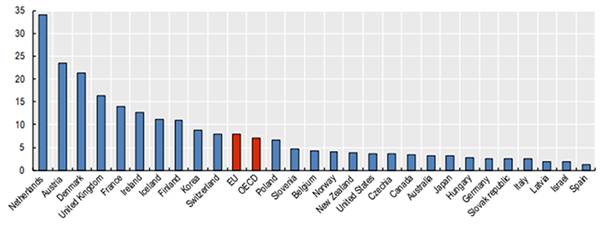
1. Action Direction: Support for vulnerable population groups Housing assistance for inhabitants is provided by local governments in cases where the Local Government Law provides for assistance to inhabitants in solving housing matters and for the promotion of the construction, maintenance, and modernisation of the housing stock. Assistance in solving housing matters is provided in accordance with the Law on Assistance in Solving Apartment Matters. Residential spaces owned or leased by a local government are primarily rented out to low-income persons or individuals belonging to categories established by the local government who are evicted from the residential space. Figure 5 Share of social housing against the total housing stock in the OECD countries in 2022, %
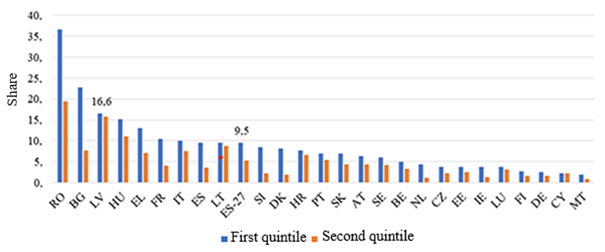
Source: OECD24 Compared to other OECD countries, Latvia has one of the smallest social housing stocks, with social housing accounting for only 2 % of the total housing stock. The shortage of social housing is highlighted not only by statistics of OECD member states but also by the European Commission25. Although the social housing stock is very small, these dwellings are in poor technical condition. According to Eurostat, around 16 % of the lowest-income households (in the first and second income quintiles) face very poor living conditions which considerably exceeds the EU average. Given that the housing stock in other OECD countries is considerably larger, Latvia is one of those countries that provides assistance to relatively narrow categories of persons. Figure 6 Share of households in very poor living conditions in the first and second income quintiles in 2020, %
Source: Eurostat26 Given that the social housing stock in Latvia is low, nearly every local government has a waiting list for local government housing. In accordance with the information obtained from a survey of local governments conducted by the Ministry of Economics in September 2022, the number of persons registered for rent of a residential space owned or leased by a local government and included in the waiting list for social apartment rent on 1 September 2022 amounted to 5022, out of which 3819 persons were eligible for the rent of a residential space owned or leased by a local government, while 1203 persons were eligible for social apartment rent. To significantly reduce the waiting list for local government housing, the Ministry of Economics has developed an aid scheme for the construction or renovation of social housing that would allow to provide aid for the construction or renovation of at least 1500 dwellings. The aid scheme would allow to reduce the waiting list for social apartments of local governments and the waiting list for apartments to which households are entitled on a priority basis by approximately 50 %; however, to completely eliminate the waiting lists for local government housing, additional funding of around EUR 143 million would be necessary of which EUR 60 million would be allocated to dwellings of the households that are entitled to a residential space on a priority basis, while EUR 83 million would be allocated to the households that have applied for assistance in solving apartment matters in accordance with general procedures. In order to ensure that the social housing programme provides even broader support for local governments in addressing the shortage of housing stock, in the course of evaluating the current relevance and implementation aspects of the European Union fund support measures under the responsibility of the Ministry of Economics, the Ministry of Economics has initiated a proposal to redirect the funding of EUR 18.5 million initially intended for measure 4.3.1.427 to the social housing programme. The procedure for the harmonisation of the initiated amendments with the European Commission has been commenced. If the European Commission takes the decision to accept the amendments to the Operational Programme, measure 4.3.1.4 will not be implemented accordingly. In order to ensure access to various statistical data and the implementation of tasks 1.4 and 1.4.1 of the Guidelines, the MoE, in cooperation with the CSB, is currently working on technical solutions to ensure that indicators of local government assistance in solving housing matters are included in the Official Statistics Programme which would allow researchers, policy planners, and society in general to access and analyse the data. Within the framework of the Official Statistics Programme, information will be collected on the housing stock at the disposal of local governments, information on persons who have applied for, or are already receiving, support in resolving apartment matters in accordance with the procedures laid down in the Law on Assistance in Solving Apartment Matters. Currently, it is planned that the abovementioned indicators will be collected, compiled, and published once a year. On 6 June 2023, the Cabinet approved the informative report "On the Development of a Targeted and Automated Support System to Compensate for the Increase in Energy Sources Costs for Low-income and Lower-middle Income Households" developed by the Ministry of Climate and Energy that contains information on the development of a targeted energy sources support concept, and also a unified information technology solution for calculating the average per capita income of all households in Latvia. Accordingly, data from the following national registers are integrated in the relevant, developed Information System for the Compensation for the Energy Sources Costs (hereinafter - the ISCESC): data from the State Revenue Service on personal income, data from the State Social Insurance Agency on the pensions and benefits disbursed to persons, data from the Office of Citizenship and Migration Affairs on the declared and registered addresses of persons, and their contact addresses. The algorithm embedded in the ISCESC ensures the calculation of the average per capita income of households in all addresses registered in the State Unified Computerised Land Register. In order to be able to identify households that may face difficulties in covering their monthly housing expenditure, the Ministry of Climate and Energy has relied on the Organisation for Economic Co-operation and Development studies on the population's well-being and access to affordable housing which concluded that the inhabitants are able to afford housing if the total monthly housing expenditure does not exceed 30 % of the income. Total housing expenditure is understood as expenditure for rent (including land lease or taxes on land adjacent to the house), utilities (water, sewerage, heating, electricity, natural gas), and other services related to the monthly maintenance of housing (e.g., housing insurance). Statistical data on the average per capita housing expenditure of households are compiled by the Central Statistical Bureau (hereinafter - the CSB) within the framework of irregular surveys. Given that the irregular survey is conducted once every five years to obtain objective data on the average per capita housing expenditure of households, the calculations also take into account the current inflation rates in household expenditure groups compiled by the CSB. The relevant approach and calculation formula are included in the Annex to Cabinet Regulation No. 592 of 3 September 2024, Regulations Regarding State Support for Energy Supply Costs. Taking into account the abovementioned and in order to ensure a consistent approach to calculating housing expenditure of households and identifying households that may face difficulties in covering that expenditure in a long-term, the approach developed by the Ministry of Climate and Energy and the ISCESC, the key function of which is the identification of the abovementioned households, could be used. The feasibility of using the relevant approach should be evaluated in the course of developing further policy planning documents and targeted aid schemes for vulnerable population groups.
2. Action direction: Support for middle-income households Although household income gradually increases, it is still too low to build sufficient savings for the purchase or rental of modern and high-quality housing. In light of the OECD recommendation for Latvia to develop the rental market, it has been concluded that the purchasing power of inhabitants is one of the primary obstacles to the development of the rental market, especially in regions, which has resulted in insufficient private sector investments in the construction of rental buildings. In order to stimulate investment in the construction of rental housing, a new Residential Tenancy Law was adopted in 2021, prompting developers to take an interest in the construction of new rental housing. Market price of a new rental apartment of around EUR 12 per square metre makes such apartments affordable only for the groups of higher-income households residing mainly in Riga and its surroundings. The high rental price is linked to the loan repayment terms available on the market that are considerably shorter than the term of operation of a building which, in turn, restricts access to such rental apartments for middle-income households. Household income disparities between regions mean that private developers show a very little interest in constructing rental housing in the regions at market prices. An increasing number of inhabitants, especially young specialists under 35 years of age, prefer to rent rather than purchase housing in order to have greater mobility opportunities. This trend is evident in many developed European countries where 30-40 % of the population are renting their housing rather than purchasing it. Given the limited supply of rental housing in the regions, regional development centres are less attractive from a housing perspective which, in turn, discourages the attraction of specialists and retention of families in these local governments. Taking into account the OECD recommendations, existing market gaps, and the need to address the shortage of affordable rental housing, the State has developed a sustainable long-term funding solution. A fund for the construction of low-rent housing has been established with the funding of the Recovery Fund in order to improve housing affordability for those persons who cannot afford housing that meets modern construction standards and energy efficiency requirements under market conditions. According to the programme30 conditions, developers are provided a 30-year loan with low interest rates and a capital discount for the construction of affordable rental housing, and restrictions on rent level have been set. The repaid loan funding and a part of the rental payment income after the repayment of the loan will be used for the construction of further low-rent housing thus providing a long-term solution for the availability of funding. Initially, the total funding for the implementation of the low-rent housing construction aid scheme under the Recovery Fund amounts to EUR 42 900 000 which allows to finance the construction of at least 467 low-rent apartments outside Riga and the bordering local governments. However, in the future, it will be necessary to expand the scheme's territorial coverage by attracting additional funding to include the entire territory of Latvia, given that households with insufficient income are present in all local governments. Until 30 July 2024, four loan contracts (Jelgava, Tukums, Valmiera, Bauska) have been concluded for the construction of 314 apartments in total, while six further projects are under evaluation within the framework of which the available funding of the Recovery Fund will be used. In accordance with the minutes of discussions between the Ministry of Economy and the Latvian Association of Local and Regional Governments of 17 July 2024, the low-rent housing construction aid scheme is an important instrument for providing affordable housing in the regions, therefore it is important to ensure permanent availability of funding for project implementation. In order to make a significant contribution to housing development, additional sources of funding (allocation of the funding of European funds for 2021-2027, institutional investors, pension fund investments, public-private partnerships, etc.) for the development of low-rent housing need to be evaluated. Based on the State budget capacity and the budget priorities set by the Cabinet for 2025, the Ministry of Economics intends, within the framework of the annual State budget priority measures, to request additional funding for the continuous implementation of the scheme in 2026 and 2027 in the amount of EUR 30 million each year31. The fund for financing the construction of low-rent housing should contribute to increasing the supply of high-quality affordable housing in Latvia and improving the quality and energy efficiency of the housing stock. From the perspective of the purpose of the construction of a new housing stock and household income in quintile groups, low-rent housing should account for around 60 % (6000 dwellings) of all constructed dwellings each year. The steering group established by the Order No. 509 of the Ministry of Finance of 21 December 2023 has developed the framework for a possible public-private partnership solution for low-rent and affordable rental apartments, including the proposed public-private partnership structure, implementation conditions, and timetable (hereinafter - the Programme). The Programme was developed and its implementation was approved at the Cabinet meeting of 11 June 2024, in accordance with § 65 of minutes No. 2, to ensure the development of private and public partnership solutions for low-rent and affordable rental apartments, as specified in the Guidelines under action direction 2 "Support for middle-income households". The Programme aims at constructing affordable rental housing other than social housing but rather dwellings with focus on accessibility for end users who are able to acquire and retain a dwelling for an acceptable price, while leaving sufficient income for covering expenditure not related with a dwelling. The Programme is implemented by VAS "Valsts nekustamie īpašumi" [State joint-stock company State Real Estate] (hereinafter - VNĪ). VNĪ will ensure the development of the financial and economic calculations of the Programme (hereinafter - the FEC) and the obtaining of opinions from the competent authorities, assuming that VNĪ will be the leading representative of the public partner and the Programme will be implemented jointly with other public partners, i.e. local governments, based on the decisions adopted by the respective local government councils on participation in the Programme, by concluding memoranda of understanding prior to the development of the FEC. The local governments, as public partners, will join the partnership procurement contract prepared by VNĪ, transfer land for the implementation of high-maturity projects to the private partner for its use and management, assume the Programme's availability risk (select tenants and co-finance rental payments, taking into account the solvency of inhabitants and the extent of market gaps), develop the criteria for a service of general economic interest for the implementation of the Programme within their administrative territory, and make the availability payment to the private partner directly or through VNĪ (in accordance with the transaction structure recommended in the FEC). The first lot of the Programme will provide for the construction of at least 1000 affordable rental apartments by 2030 with total investments of around EUR 100 million. The exact amount will be specified within the framework of the FEC which will be developed in cooperation with the European Investment Bank. The project is being developed on the basis of the model "the private partner designs, builds, finances, operates, maintains", where the public sector availability payment is included in the State and local government budget expenditures as of 2030, along with availability of housing for inhabitants. Furthermore, according to the Programme, local governments become owners of the land and the built housing at the end of the project.
3. Action direction: Support for upper-middle-income households Given that the share of households able to purchase housing under market conditions is relatively low, continuous State support is necessary for households with stable income but insufficient savings to make the down payment for the purchase or building of a dwelling. To promote housing affordability for such households, since 2015 families have access to a State guarantee for the purchase or building of own dwelling. The housing guarantee programme is very well received by families: over 27 000 guarantees for families with more than 38 000 children have been issued since the guarantee programme was launched. With the State funding allocated so far, guarantees have been issued in an amount exceeding EUR 223 million, while the total amount of the issued mortgage loans exceeds EUR 1.9 billion. Guarantees have had a significant impact on the country's mortgage loan market, i.e. each year, around 40 % of all newly issued mortgage loans are backed by a guarantee. Given that the majority of the guarantees were issued in Riga and its surroundings, on 24 April 2024, the Cabinet amended the aid scheme to provide more support for families residing outside Riga and Pieriga. Table 1 Available aid under the housing guarantee programme for families by the number of children and location of the purchased housing in the region
Since 2018, aid in form of a guarantee has also been available to young specialists, i.e. persons with vocational secondary or higher education under the age of 35. 5822 young specialists had used the guarantee by 31 March 2023, with guarantees issued in the amount of EUR 48 million. At the end of 2023, the Cabinet approved that in order for ALTUM to be able to respond promptly to fluctuations in EURIBOR rates, as from now the guarantee fee for young specialists will be specified in the ALTUM price list and may not exceed the currently established rate of 4.8 %. ALTUM and the Ministry of Economics have agreed that the guarantee fee for young specialists will be reduced to 2.4 % for one year; however, after 12 months, a decision will be made once again on the possibility of maintaining the reduced guarantee fee. Since July 2020, the support mechanism "Balsts" has been available to large families to promote housing affordability, providing them with the possibility to receive a subsidy for the purchase or construction of housing. Since December 2023, the subsidy "Balsts" has also been available to families raising a child with a disability, regardless of the number of children in the family. 1335 families with over 4000 children have used the subsidy so far, with the funding granted in form of subsidies exceeding EUR 11.7 million. In order to facilitate the availability of the subsidy "Balsts" for families, the Ministry of Economics has been working on amendments to the aid scheme by intending to increase the income threshold required for families to be eligible for the subsidy. In order to promote competition on the financial service market, and also encourage mortgage lending in the regions, the Ministry of Economics developed, and the Cabinet approved in September 2024, amendments to the aid scheme that provide for the possibility for non-bank financial institutions or credit unions to issue mortgage loans backed by a guarantee and (or) a subsidy.
4. Action direction: Support for the improvement of the existing housing stock The existing housing stock in Latvia is rapidly ageing. Since the restoration of Latvia's independence, around 10 % of all residential buildings have been built after 2003, while only 3 % of the total share of multi-apartment buildings have been built after 2003 (4 % since 199334). Investments in housing in Latvia have been low due to various reasons, including due to the low income and decline in the number of inhabitants. Lack of investments in housing is also highlighted in the OECD study on housing affordability in Latvia35. In 2023, Latvijas Banka made several amendments to the Regulations on Credit Risk Management, and in addition to the current 40 % DSTI (debt service-to-income, i.e. the borrower's maximum net monthly income ratio) and six times DTI (debt-to-income, i.e. the borrower's maximum net annual income ratio) limits, relaxed DSTI and DTI limits (45 % and eight times, respectively) were established for loans granted to consumers for the purchase of energy-efficient housing. These incentives apply to dwellings with an energy performance certificate rated A+, A, B or C. Amendments to differentiated DSTI and DTI requirements will improve the affordability of energy-efficient dwellings, thereby contributing to the development of a more sustainable housing stock. Such incentives were provided given that savings from relatively lower heating costs in an energy-efficient dwelling, compared with an equivalent dwelling that is not energy-efficient, can be redirected towards loan repayments. In order to encourage investments in the improvement of the housing stock, it is also necessary to ensure effective management of multi-apartment residential houses with clearly defined responsibilities and obligations of the administrator and apartment owners. The Ministry of Economics is developing a new law on administration of multi-apartment residential houses which provides for the establishment of legal preconditions for effective administration of multi-apartment residential houses, thereby ensuring the operation and maintenance of residential houses (physical preservation throughout their entire service life) and their development in accordance with the requirements of laws and regulations, while also clearly defining the rights and obligations of apartment owners, the community of apartment owners, joint owners, administrators of residential houses, and other persons involved in the administration of the residential house. Given the low level of interest of the inhabitants in maintaining their housing stock, on 30 May 2024, the Saeima approved amendments to the Law on Residential Properties, thereby allowing a minority of multi-apartment residential house owners to decide on the maintenance and renovation of a multi-apartment residential building if the initially convened general meeting does not have a quorum. The meeting may be reconvened within one month of the initial general meeting, and it will be deemed to have a quorum if more than one third of all apartment owners participate. The amendments to the Law aim at improving the decision-making procedure of the community of apartment owners to ensure the successful administration of residential houses, and also achieve the energy efficiency targets set in the European Union. Furthermore, with coming into force of amendments to the Law on 1 November 2024, protection will be determined for those apartment owners who are active in the administration of the residential house but are in the minority and therefore unable to make decisions due to the inaction of the majority. In line with the European Commission's Renovation Wave Strategy, Latvia must achieve climate neutrality in the building sector by 2050. In order to reach this objective, around 26 600 multi-apartment residential houses must be renovated. An analysis of the current situation, especially in the regions, suggests that a significant barrier to accelerating the pace of the renovation of multi-apartment buildings is the financial resources of residents, especially the financial capacity of needy and low-income households to implement energy efficiency measures. Accordingly, it is necessary to provide aid to households with the status of a needy or a low-income person to avoid placing an additional financial burden on them. A possible solution would be for the State to cover payments for loans issued to needy and low-income persons, including the loan interest rates, through energy efficiency measures in multi-apartment buildings. This would allow lowest-income persons to improve their living conditions and quality of life, while not discouraging other residents of the building from carrying out renovation. The provision of aid to 500 needy or low-income persons would require around EUR 462 000 per year from the State budget funds.36
1 Housing Affordability Guidelines 2023-2027, available: https://likumi.lv/ta/id/347211-par-majoklu-pieejamibas-pamatnostadnem-2023-2027-gadam 2 On the Government Action Plan for the Implementation of the Declaration of the Intended Measures of the Cabinet Led by Evika Siliņa, measures 18.1 and 18.2, available: https://m.likumi.lv/ta/id/349266-par-valdibas-ricibas-planu-deklaracijas-par-evikas-silinas-vadita-ministru-kabineta-iecereto-darbibu-istenosanai 3 Task 3.1: To ensure the availability of funding for granting the subsidy "Balsts" for large families for the purchase or construction of housing; Task 3.1.1: To intend granting of the subsidy "Balsts" for families raising a child with a disability 4 Task 4.1: To include in the Law on Administration of Residential Houses a regulation on administration of residential houses where the administration rights have not been taken over 5 Task 4.2: To evaluate and review the rights of an individual apartment owner or a joint owner of the residential house to request actions and manage the residential house, ensuring protection against the inaction of the majority 6 Task 4.7: To develop an aid scheme for improving environmental accessibility in apartment buildings by constructing lifts 7 Portal of Official Statistics of Latvia, Number of new apartments commissioned (2023), available: https://data.stat.gov.lv/pxweb/en/OSP_PUB/START__NOZ__BU__BUE/BUE021/, Portal of Statistics of Estonia, Number of new dwellings commissioned (2023), available: https://andmed.stat.ee/en/stat/majandus__ehitus__ehitus-ja-kasutusload/EH045/table/tableViewLayout2, Portal of Statistics of Lithuania, Number of new dwellings commissioned (2023), available: https://osp.stat.gov.lt/statistiniu-rodikliu-analize?hash=22fa9851-b65a-4369-b528-286ecf206f55#/ 8 Total number of dwellings in Estonia: 747 thousand, in Lithuania: 1.5 million, in Latvia: 1 million. Sources: Latvia: https://data.stat.gov.lv/pxweb/en/OSP_PUB/START__POP__MA__MAS/MAS070/, Lithuania: https://osp.stat.gov.lt/en//statistiniu-rodikliu-analize?hash=c15a6982-e4a5-40c6-8274-4d2b5a7f2f36#/, Estonia: https://www.stat.ee/en/find-statistics/statistics-theme/economy/housing 9 Eurostat, Distribution of household income by purchasing power in EU Member States (2022), available: https://ec.europa.eu/eurostat/databrowser/view/sdg_10_20/default/bar?lang=en 10 Makroekonomika.lv, Mājokļu tirgus aktivitātes un mājokļu kreditēšanas tendences - neilgtspējīgā līdzsvarā?, available in Latvian: https://www.makroekonomika.lv/raksti/majoklu-tirgus-aktivitates-un-majoklu-kreditesanas-tendences-neilgtspejiga-lidzsvara 11 Eurostat, Gross fixed capital formation by AN_F6 asset type, https://ec.europa.eu/eurostat/databrowser/view/NAMA_10_AN6__custom_10363454/default/table?lang=en 12 Eurostat, Housing Price Index, available: https://ec.europa.eu/eurostat/databrowser/view/PRC_HPI_A__custom_11654773/default/table?lang=en 13 Eurostat, Share of households by tenure status (2023), available: https://ec.europa.eu/eurostat/databrowser/view/ILC_LVHO02__custom_7139277/bookmark/table?lang=en&bookmarkId=6eeb03d1-dd59-4bb4-a9b8-ad21bed9cd21 14 Portal of Official Statistics, Conventional dwellings by type of building and by year of construction (2021), available in Latvian: https://data.stat.gov.lv/pxweb/en/OSP_PUB/START__POP__MA__MAS/MAS070/ 15 Source of data: Information provided by local governments 16 Source of data: Information published by the Central Statistical Bureau 17 Source of data: Information compiled by the MoE 18 Source of data: Information compiled by the MoE 19 Source of data: Information compiled by the MoE 20 Source of data: Information compiled by the MoE 21 Source of data: Information published by the Central Statistical Bureau 22 Source of data: Information provided by the Ministry of Welfare and local governments 23 Source of data: Information published by the Central Statistical Bureau 24 OECD, Social Housing Stock, available: https://www.oecd.org/els/family/PH4-2-Social-rental-housing-stock.pdf 25 European Commission proposal for the Council Recommendations to Latvia in 2023, available: https://commission.europa.eu/system/files/2023-05/COM_2023_614_1_EN.pdf 26 Eurostat, Severe housing deprivation rate by income quintile, available: https://ec.europa.eu/eurostat/databrowser/view/ilc_mdho06q__custom_11893488/default/table?lang=en 27 Measure 4.3.1.4 "Improving the environmental accessibility in apartment buildings by installing lifts" of the priority direction "Employment and social inclusion" of the EU Cohesion Policy Programme 2021-2027 28 Regulations on the implementation of measure 4.3.1.3 "Renovation of social housing or construction of new social housing" of the specific support objective 4.3.1 "Promoting the socio-economic inclusion of marginalised communities, low-income households and disadvantaged groups, including people with special needs, by implementing integrated actions, including ensuring housing and social services" of the European Union Cohesion Policy Programme 2021-2027 29 The aid scheme does not contribute to the implementation of the requirements laid down in Article 6 of Directive (EU) 2023/1791 of the European Parliament and of the Council of 13 September 2023 on energy efficiency and amending Regulation (EU) 2023/955 (recast), nor to achieving the energy efficiency targets set out in the updated National Energy and Climate Plan 2021-2030 (approved by Cabinet Order No. 573 of 12 July 2024). 30 Cabinet Regulation No. 459 of 14 July 2022, Regulations on Support for the Construction of Residential Rental Housing within the Framework of Investment 3.1.1.4.i "Establishing a Financing Fund for the Construction of Low-rent Housing" of Reform and Investment Direction 3.1 "Regional Policy" of the European Union Recovery and Resilience Facility Plan, available in Latvian: https://likumi.lv/ta/id/334085-noteikumi-par-atbalstu-dzivojamo-ires-maju-buvniecibai-eiropas-savienibas-atveselosanas-un-noturibas-mehanisma-plana-31-reformu-un-investiciju-virziena-regionala-politika-3114i-investicijas-finansesanas-fonda-izveide-zemas-ires-majoklu-buvniecibai-ietvaros 31 Within the framework of measure 2.1.3. 32 Cabinet Regulation No. 1065 of 15 September 2009, Regulations Regarding Loans for Promoting the Development of Micro, Small And Medium Sized Merchants and Agricultural Service Co-operative Societies, available:https://likumi.lv/ta/en/en/id/198282-regulations-regarding-loans-for-promoting-the-development-of-micro-small-and-medium-sized-merchants-and-agricultural-service-co-operative-societies 33 Cabinet Regulation No. 383 of 16 June 2020, Regulations Regarding Guarantees for Performers of Economic Activity for the Improvement of Competitiveness, available: https://likumi.lv/ta/en/en/id/315560-regulations-regarding-guarantees-for-performers-of-economic-activity-for-the-improvement-of-competitiveness, and Cabinet Regulation No. 537 of 5 September 2017, Regulations Regarding Portfolio Guarantees for the Promotion of Crediting of Micro, Small, and Medium-sized Performers of Economic Activity which Are Legal Persons, available: https://likumi.lv/ta/en/en/id/293402-regulations-regarding-portfolio-guarantees-for-the-promotion-of-crediting-of-micro-small-and-medium-sized-performers-of-economic-activity-which-are-legal-persons 34 Information provided by the SLS 35 "Policy Actions for Affordable Housing in Latvia", OECD, 2020: https://issuu.com/oecd.publishing/docs/latvia_housing_report_web-1 36 Within the framework of measure 4.14.1 37 Implementation Regulations of Investment 1.2.1.1.i "Improving the Energy Efficiency of Multi-apartment houses and Transition to Renewable Energy Technologies" of Reform and Investment Direction 1.2 "Improving Energy Efficiency" of the European Union Recovery and Resilience Facility Plan, available: https://likumi.lv/ta/id/334084-eiropas-savienibas-atveselosanas-un-noturibas-mehanisma-plana-1-2-reformu-un-investiciju-virziena-energoefektivitates-uzlabosana Minister for Economics V. Valainis
Translation © 2025 Valsts valodas centrs (State Language Centre) |
Tiesību akta pase
Nosaukums: Mājokļu pieejamības pamatnostādņu 2023.–2027. gadam īstenošanas plāns 2024.–2027. gadam
Izdevējs: Ministru kabinets
Veids:
rīkojums
Numurs: 1054Pieņemts: 09.12.2024.Stājas spēkā: 09.12.2024.Publicēts: Latvijas Vēstnesis, 240, 10.12.2024.
OP numurs:
2024/240.4
Dokumenta valoda:   Politikas plānošanas dokuments Nosaukums: Mājokļu pieejamības pamatnostādņu 2023.–2027. gadam īstenošanas plāns 2024.–2027. gadam Veids: planPolitikas joma: Mājokļu politika Atbildīgā iestāde: Ministry of Economics Saistītie dokumenti
|
||||||||||||||||||||||||||||||||||||||||||||||||||||||||||||||||||||||||||||||||||||||||||||||||||||||||||||||||||||||||||||||||||||||||||||||||||||||||||||||||||||||||||||||||||||||||||||||||||||||||||||||||||||||||||||||||||||||||||||||||||||||||||||||||||||||||||||||||||||||||||||||||||||||||||||||||||||||||||||||||||||||||||||||||||||||||||||||||||||||||||||||||||||||||||||||||||||||||||||||||||||||||||||||||||||||||||||||||||||||||||||||||||||||||||||||||||||||||||||||||||||||||||||||||||||||||||||||||||||||||||||||||||||||||||||||||||||||||||||||||||||||||||||||||||||||||||||||||||||||||||||||||||||||||||||||||||||||||||||||||||||||||||||||||||||||||||||||||||||||||||||||||||||||||||||||||||||||||||||||||||||||||||||||||||||||||||||||||||||||||||||||||||||||||||||||||||||||||||||||||||||||||||||||||||||||||||||||||||||||||||||||||||||||||||||||||||||||||||||||||||||||||||||||||||||||||||||||||||||||||||||||||||||||||||||||||||||||||||||||||||||||||||||||||||||||||||||||||||||||
|
Šajā vietnē oficiālais izdevējs "Latvijas Vēstnesis" nodrošina tiesību aktu sistematizācijas funkciju. Sistematizēti tiesību akti ir informatīvi. Pretrunu gadījumā vadās pēc oficiālās publikācijas. |
Par Likumi.lv Aktualitātes Atsauksmēm Apmācības Kontakti |
Mobilā versija Lietošanas noteikumi Privātuma politika Sīkdatnes Piekļūstamība |
|