Aicinām vēl šonedēļ piedalīties lietotāju apmierinātības aptaujā!
Paldies par viedokli!

|
Decision No. 1/7 of the Board of the Public Utilities Commission Adopted 4 August 2022 Methodology for the Calculation of Tariffs and Calculation and Attribution of Costs in the Electronic Communications SectorIssued pursuant to
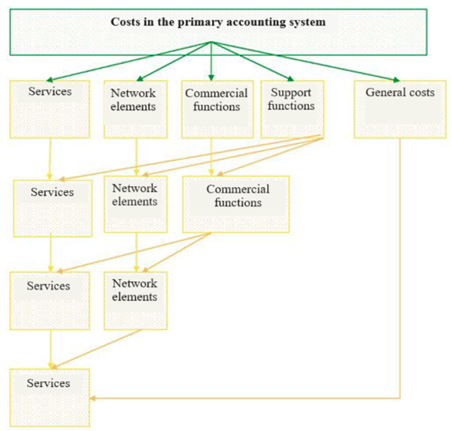
Section 84, Paragraphs five and seven 1. General Provisions1. The methodology prescribes the procedures by which an electronic communications merchant (hereinafter - the merchant) with significant market power for which the Public Utilities Commission (hereinafter - the Regulator) has imposed an obligation to comply with this methodology shall: 1.1. calculate tariffs, calculate and attribute costs for its electronic communications services provided in the electronic communications service market in which it has been designated as having significant market power; 1.2. keep separate accounting if the merchant has been imposed an obligation of accounting separation; 1.3. submit to the Regulator a report on compliance of the calculation and attribution of costs with the system for the calculation and attribution of costs (hereinafter - the report), and also the amount of information to be included in the report. 2. The following terms are used in this methodology: 2.1. activity - an action necessary to ensure the provision of a specific electronic communications service; 2.2. joint account of costs - an account within the cost accounting system where costs are entered; 2.3. cost driver - a factor linking cost accounts on the basis of causation; 2.4. regulatory asset base - fixed assets and intangible investments necessary for efficient provision of services. The value of the regulatory asset base shall correspond to the value of the capital attracted for the provision of long-term services (equity capital and long-term credits); 2.5. current cost accounting - accounting of costs of the merchant, taking into account the value of assets after revaluation and respecting the capital maintenance principles; 2.6. primary accounting system - the accounting system and related management accounting systems; 2.7. network element - an electronic communications network device or group of devices which ensures performance of specific functions in the electronic communications network; 2.8. net revenue - revenue obtained by the merchant as a result of the sale of goods and services, minus discounts, taxes, and outstanding payment for the services provided. 3. This methodology shall be applied to the calculation of tariffs and costs of both retail and wholesale services if the Regulator has designated the merchant as having significant market power in the relevant service market and has imposed an obligation thereon to calculate tariffs and costs in accordance with this methodology. 4. The merchant shall, on the basis of this methodology, establish and apply a system for the calculation and attribution of costs, taking into account the specific nature of activity of the particular merchant. 5. The merchant subject to the requirements in respect of the system for the calculation and attribution of costs shall publish a description of the system for the calculation and attribution of costs, indicating the main cost groups as well as the cost attribution rules. 6. The merchant upon which the Regulator has imposed an obligation to comply with this methodology, and also an obligation to align tariffs with costs, calculate and attribute costs of electronic communications services has an obligation to align tariffs with costs that have been calculated in accordance with the procedures for the calculation and attribution of costs specified in this methodology. 7. The merchant upon which an obligation to ensure a sufficient price difference for wholesale and retail services has been imposed shall follow the methodology stipulated by the Regulator for the calculation of a sufficient price difference in the electronic communications sector. 8. The merchant with significant wholesale market power in the access and interconnection field upon whom the Regulator has imposed an obligation of accounting separation shall comply with the procedures laid down in Chapter 4 of this methodology for keeping separate accounting. 2. Calculation of Tariffs9. If an obligation of tariff regulation has been imposed upon the merchant to respect the upper limit of the tariff, the merchant shall apply such tariff to the service provided which does not exceed the specified upper limit of the tariff. 10. If the merchant does not have an obligation to respect the upper limit of the tariff but has an obligation to calculate the tariff in accordance with the methodology stipulated by the Regulator, the merchant shall determine the tariff by calculating service costs and add to the calculated costs the capital financing costs which are calculated in accordance with the procedures laid down in Chapter 3 of this methodology. 3. Calculation and Attribution of Costs3.1. Principles of the Calculation and Attribution of Costs11. The merchant shall calculate costs of the electronic communications service by summing up the costs of activity and capital financing costs specified in accordance with this methodology and attributed to the electronic communications service. 12. When attributing costs to the electronic communications services, the merchant shall use and adjust the cost base as follows: 12.1. the merchant shall use its annual statement prepared in accordance with the Law on the Annual Statements and Consolidated Annual Statements as the basis for the calculation of costs of the electronic communications services; 12.2. the merchant shall replace the actual capital financing costs presented in the annual statement with the capital financing costs calculated in accordance with this methodology. 13. For the purpose of attribution of costs, the merchant shall introduce at least the following general account groups in the system for the calculation and attribution of costs (hereinafter - the internal accounting system): 13.1. services - accounts for costs related only to the specific electronic communications service or provision of the particular electronic communications service; 13.2. network elements - accounts for costs related to particular network elements involved in the provision of several electronic communications services; 13.3. commercial functions - accounts for costs related to the planning, development, management, and operation of an electronic communications network, marketing, accounting, and settlement of accounts; 13.4. support functions - accounts for costs related to the provision of computer systems, maintenance of buildings and structures, administration, and other support functions; 13.5. general costs - accounts for costs that cannot be attributed to particular services but rather to the overall activity of the merchant. 14. The merchant shall attribute costs to the electronic communications services on the basis of the following principles of attribution of costs: 14.1. costs shall be attributed to such services the provision of which directly or indirectly incurs the relevant cost (i.e., on the basis of causation); 14.2. cost attribution analysis shall be performed for each item of revenue, cost; 14.3. numerically measurable and assessable cost drivers shall be used for the attribution of costs; 14.4. where possible, costs shall be directly attributed to services; 14.5. where costs cannot be directly attributed, each step of the attribution of costs shall be based on cost drivers. 15. The merchant shall break down the costs in its internal accounting system in the following categories: 15.1. direct and directly attributable costs which may be directly and unequivocally attributed to the electronic communications service and which are indicated in the cost accounting system of the merchant as costs of the relevant service; 15.2. indirect costs which include the common costs of several services and which may be attributed to a specific electronic communications service with the help of the cost driver; 15.3. general costs which may not be attributed, on the basis of causation, to any specific service. 16. The merchant shall attribute the direct costs, using cost drivers. 17. For the purpose of attributing general costs to services, the merchant shall, at its own discretion, employ one of the following methods: 17.1. gross revenue method - general costs shall be attributed to the service in proportion to its turnover in the total turnover of the merchant; 17.2. net revenue method - general costs shall be attributed to the service in proportion to its revenue in the net revenue of the merchant; 17.3. attributed cost method - general costs shall be attributed to the service in proportion to the attributed costs. 18. The general costs attributed to the electronic communications service shall not exceed 10 % of all costs attributed to the relevant service. 19. The following actions are taken within the process of the attribution of costs: 19.1. the merchant shall gradually transfer costs from the primary accounting system to cost accounts in conformity with the following conditions: 19.1.1. direct costs shall be entered in service accounts; 19.1.2. indirect costs, depending on their causes, shall be entered in the network element account, commercial function account, support function account, and general cost account; 19.2. support function costs shall be attributed to commercial functions, network elements, and directly to services; 19.3. commercial function costs shall be attributed to network elements and directly to services; 19.4. network element costs shall be attributed to services; 19.5. general costs shall be attributed to services. 20. The diagram for the process of attribution of costs is included in Annex 1 to this methodology. 3.2. Operating Costs21. The merchant shall, in its internal accounting system, break down the operating costs in the following cost groups: 21.1. delivery, installation, and running costs; 21.2. planning and development costs of the electronic communications network; 21.3. management costs of the electronic communications network; 21.4. marketing and trade costs; 21.5. accounting and settlement costs; 21.6. operator service costs; 21.7. payments to other electronic communications service providers; 21.8. support function costs; 21.9. costs of financing the inventories. This item shall include costs of financing the maintenance of the inventories according to the planned life cycle of the supplies, applying the actual rate of loans of the merchant. If the actual rate of a loan applied to evaluate the costs of financing the inventories exceeds the average variable interest rate (for new transactions) of short-term credits (euro) issued to non-financial corporations published by Latvijas Banka for the last six months according to the amounts of inventories, the costs of financing maintenance of the supplies shall be evaluated by applying the average variable interest rate (for new transactions) of short-term credits (euro) issued to non-financial corporations published by Latvijas Banka for the last six months according to the amounts of inventories. 22. The merchant may introduce additional cost groups according to the special nature of activity. 23. The merchant shall attribute operating costs to electronic communications services in accordance with the procedures laid down in Sub-chapter 3.1 of this methodology. 3.3. Costs of Capital Financing and Regulatory Asset Base24. The merchant shall attribute the fixed assets and intangible investments used for the provision of electronic communications services as follows: 24.1. the fixed assets and intangible investments of the electronic communications network which are recorded in the primary accounting system by network elements shall be entered in the general network element accounts; 24.2. if the fixed assets and intangible investments of the electronic communications network are recorded in the primary accounting system by broader groups than the network elements in the internal accounting system, engineering information shall be used to attribute them to network element accounts; 24.3. other fixed assets and intangible investments shall be attributed to commercial function and support function accounts; 24.4. depreciation and amortisation shall be attributed to the joint accounts of costs in proportion to the fixed assets attributed thereto. 25. The merchant shall calculate the costs of capital financing by applying the rate of return on capital calculated by the Regulator in accordance with the methodology for the calculation of a sufficient price difference in the electronic communications sector. 26. The merchant shall apply in the calculation of the costs of capital financing the rate of return on capital calculated by the Regulator to the value of the regulatory asset base which has been determined at the end of the previous calendar year. 27. If the Regulator has imposed a premium for the rate of return on capital on the merchant in relation to investments in a high-performance network, then the merchant shall calculate financing costs of the abovementioned project, applying an increased rate of return on capital for the capital investments of this project which is obtained by summing up the rate of return on capital calculated by the Regulator as referred to in Paragraph 25 of this methodology and the premium for the rate of return on capital specified in the decision of the Regulator. In order for the Regulator to take a decision on the premium for the rate of return on capital: 27.1. the merchant shall submit a submission to the Regulator, indicating a justification for the risks associated with the particular investment project involving the high-performance network; 27.2. the Regulator shall assess the risks indicated in the submission referred to in Sub-paragraph 27.1 of this methodology so that the merchant can achieve a reasonable return on the invested capital, and shall impose or refuse to impose the premium for the rate of return on capital. 28. The merchant shall, in proportion to the assets involved, attribute the costs of capital financing to the network elements, activities, or services. 29. Depreciation of fixed assets shall be calculated in accordance with the international accounting standards and the accounting policy adopted by the merchant. If the fixed assets have not been fully used for the provision of the service, the calculated depreciation shall be adjusted according to efficient use of the fixed assets. 30. The write-off (amortisation) of the intangible investment value shall be calculated for the research and development costs, the costs arising from concessions, patents, licences, trademarks, and other intangible investments (except for the intangible value of the merchant), taking into account the international accounting standards and the accounting policy adopted by the merchant. 3.4. Revenue Allocation31. The merchant shall attribute revenue to electronic communications services in conformity with the following basic principles of revenue attribution: 31.1. the revenue generated from the sale of the electronic communications service shall be directly attributed to this electronic communications service; 31.2. the revenue that cannot be directly attributed to a specific electronic communications service shall be attributed according to the connection thereof with the electronic communications services provided. 32. Other revenue shall be shown by the merchant as revenue from other types of activities. 4. Separate Accounting33. The merchant shall keep separate accounting for the following service groups: 33.1. provision of services in the access and interconnection wholesale market in which the merchant has been imposed an obligation of accounting separation; 33.2. provision of other services. 34. For the service groups specified in Paragraph 33 of this methodology, the merchant shall prepare a profit or loss account in accordance with Annex 2 to this methodology. 35. The merchant shall prepare the account specified in Paragraph 34 of this methodology in conformity with the approach for the attribution of revenue and costs specified in Chapter 3 of this methodology, and also the approach for the calculation of the cost of capital financing. The merchant shall submit the prepared account to the Regulator, together with a report in accordance with the requirements laid down Chapter 5 of this methodology. 5. Report36. The merchant shall, within seven months after the end of the current reporting year, prepare and submit the report to the Regulator. 37. The merchant shall include the following information on the previous reporting year in the report: 37.1. a description of the internal cost system established and applied by the merchant; 37.2. a profit or loss account in accordance with the sample appended in Annex 2 to this methodology; 37.3. a report on the attribution of costs, indicating the values of attributed costs and cost drivers according to the diagram for the attribution of costs; 37.4. a report on the attribution of fixed assets and intangible investments in accordance with Paragraphs 24 and 25 of this methodology, indicating the values of attributed fixed assets and intangible investments by network elements, commercial functions, and support functions, and also the depreciation and amortisation costs thereof; 37.5. a calculation of the costs of capital financing in accordance with Paragraphs 25, 26, 27, and 28 of this methodology; 37.6. a report on the services provided by the merchant in accordance with the sample appended in Annex 3 to this methodology. 38. The merchant subject to the requirements in respect of the system for the calculation and attribution of costs shall, each year, publish a report of the sworn auditor on the compliance of the calculation and attribution of costs carried out by the merchant in the reporting year with the system of the merchant for the calculation and attribution of costs, and the compliance of this system with the methodology. 6. Closing Provisions39. Decision No. 1/40 of the Public Utilities Commission of 19 December 2013, Methodology for the Calculation and Attribution of Costs of Electronic Communications Services (Latvijas Vēstnesis, 2013, No. 253), is repealed. 40. Decision No. 1/14 of the Public Utilities Commission of 15 October 2015, Methodology for the Calculation of Tariffs of Electronic Communications Services (Latvijas Vēstnesis, 2015, No. 205), is repealed. 41. This methodology shall come into force on the day following its publication in the official gazette Latvijas Vēstnesis. Chair of the Board of the Public Utilities Commission A. Ozola
Annex 1 Diagram for the Attribution of Costs
Annex 2 Profit or Loss Account
The table shall be completed for the following: 1) provision of electronic communications services in the market in which the merchant has been designated as having significant market power and obliged to comply with this methodology (for each market separately); 2) provision of services in the access and interconnection wholesale market in which the merchant with significant market power has been imposed an obligation of accounting separation; 3) provision of other services (in total). Date _______ ________ _______________________
Note. The details of the document "date" and "signature" need not be completed if the electronic document has been prepared in accordance with the laws and regulations regarding drawing up of electronic documents.
Annex 3 Report on the Services Provided by the Merchant in the Reporting Year
The table shall include all electronic communications services provided by the merchant in service markets in which the merchant has been designated as having significant market power and obliged to comply with this methodology. The merchant who has been imposed only an obligation of accounting separation in the access and interconnection wholesale market shall not be obliged to prepare and submit this table. The unit for which the cost is calculated - minute, connection, etc. Date _______ ________ _________________
Note. The details of the document "date" and "signature" need not be completed if the electronic document has been prepared in accordance with the laws and regulations regarding drawing up of electronic documents. Translation © 2024 Valsts valodas centrs (State Language Centre) |
Document information
Title: Tarifu aprēķināšanas un izmaksu aprēķināšanas un attiecināšanas metodika elektronisko sakaru ..
Status:
In force
Language:   Related documents
|
||||||||||||||||||||||||||||||||||||||||||||||||||||||||||||||||||||||||||||||||||||||||||||||||||||||||||||||||||||||
|
Latvijas Vestnesis, the official publisher ensures legislative acts systematization function on this site. All Likumi.lv content is intended for information purposes. |
About Likumi.lv News archive For feedback Training Contacts |
Mobile version Terms of service Privacy policy Cookies Accessibility |
|